

The WTO in March 2026 raised its projection for 2026 global merchandise trade volume growth to 1.9% (from 0.5% in its October 2025 projection).
Also, it introduced 2027 growth at 2.6%, quoting a surge in AI-related products, adaptations in supply chains and the avoidance of tit-for-tat retaliation on tariffs.
The outlook, according to Kenanga Research, is facing fresh challenges from escalating tensions in the Middle East and persistently elevated energy prices, both of which could spill over into food supply chains and increase operating costs for businesses while putting additional pressure on consumers.
According to projections, a prolonged high-energy-price environment could slow global merchandise trade growth to 1.4%, down from an expected 1.9%, effectively trimming growth by half a percentage point.
Meanwhile, disruptions to shipping routes remain a concern. Ongoing diversions away from the Red Sea have continued to affect global trade flows, particularly on the crucial Asia-Europe corridor.
With vessels bypassing the Suez Canal in favour of the longer Cape of Good Hope route, shipping journeys are taking more time, reducing the number of port calls carriers can make.
This has implications for ports across the region, including those operated by Westports, given that the Asia-Europe route accounts for roughly 30% of global container traffic.
On the domestic front, higher fuel prices resulting from reduced traffic through the Straits of Hormuz are expected to have limited impact on logistics companies.
This is because eligible operators can still obtain diesel at the subsidised rate of RM2.15 per litre through Malaysia’s targeted diesel subsidy programme using fleet cards.
Seaport operators, however, do not enjoy the same subsidy and must purchase diesel at market rates.
Even so, any increase in fuel costs could be partly offset by higher container storage revenue should port congestion worsen as shipping movements through the region slow.
Separately, the World Trade Organization has highlighted the growing importance of so-called “connecting economies” — countries that have benefited from trade diversions linked to the US-China rivalry.
Among the key beneficiaries are Malaysia, Singapore, India and Vietnam, which have increasingly positioned themselves as intermediaries trading across competing geopolitical blocs.
This emerging role could help cushion these economies against the broader risks of global trade fragmentation.
Based on the latest Malaysia’s external trade in February 2026, exports to the US recorded a strong growth of 42.3% year-on-year (higher than January’s 33.9%) due to robust demand for E&E products.
The US now is Malaysia’s largest export destination during the month.
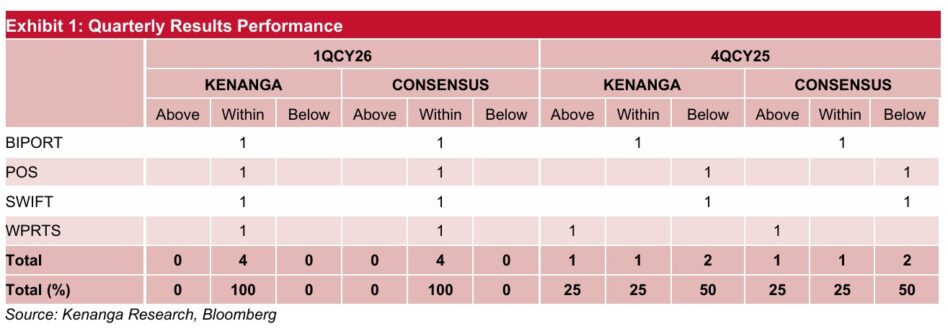
Kenanga expects domestic logistic sector growth to remain steady in 2026, which is a beneficiary of the booming e-commerce, supported by the global tech up-cycle led by AI data centre demand, a resilient US economy, and potential trade diversion amid US-China trade tensions.
The domestic logistics sector still fared better as Malaysia’s total trade moderated to 9.5% in February 2026 (Jan: 12.3%), while trade surplus narrowed to RM16.7 bil in the same period (Jan: RM22.2 bil), especially in the domestically driven third-party logistics (3PL) sector, which is less vulnerable to external headwinds, being buoyed by booming e-commerce.
Local players such as SWIFT, however, are faced with intense competition from Chinese players which constrain local players’ ability to fully leverage on Malaysia’s strong total trade growth.
This situation arises due to the irrational pricing set by Chinese logistics players despite the rising logistics operating costs and Chinese logistics players typically come in as a package following the new entrant of China’s foreign direct investment.
There is also strong demand for cold-storage warehouses on the back of the proliferation of online grocery start ups.
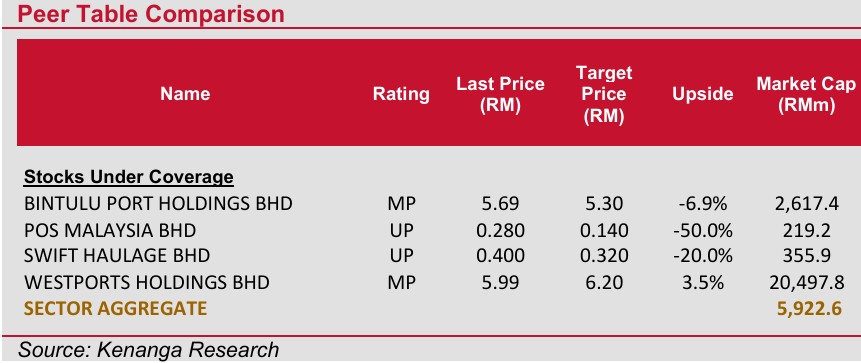
“We maintain Neutral on the sector with no top pick at the moment,” said Kenanga. —June 9, 2026
Main image: centurionlgplus.com