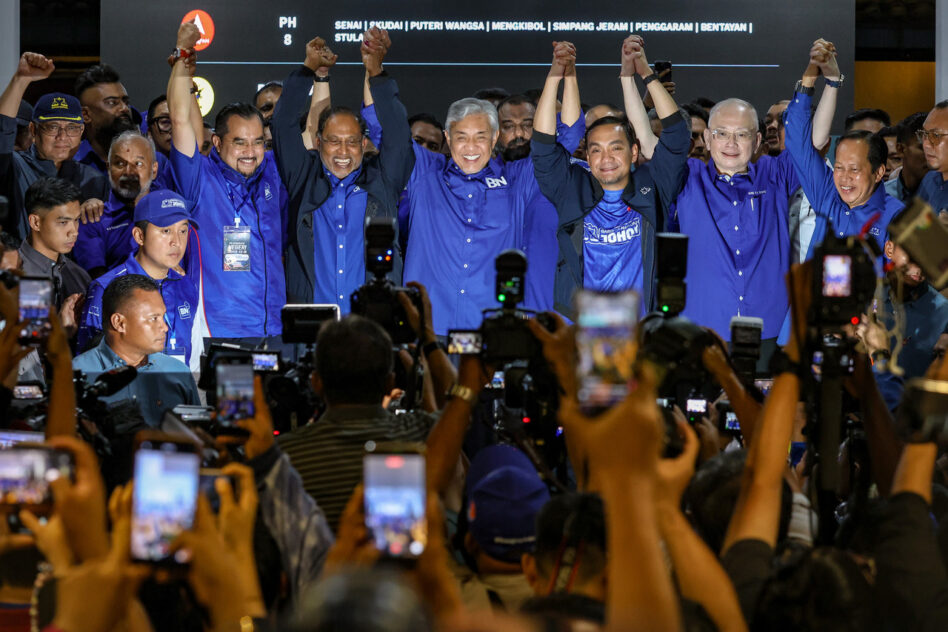


IF Johor demonstrated Barisan Nasional’s (BN) electoral resurgence, developments surrounding the Negeri Sembilan state election have highlighted a more complex challenge confronting Malaysia’s Unity Government.
BN’s decision to cooperate electorally with Perikatan Nasional (PN) while remaining a governing partner with Pakatan Harapan (PH) at the federal level illustrates the increasingly complicated realities of Malaysia’s coalition politics.
The issue extends beyond state electoral strategy, raising broader questions about political consistency, coalition cohesion and the long-term sustainability of the Unity Government.
Coming on the heels of BN’s strong showing in Johor, the Negeri Sembilan arrangement has reinforced perceptions within the coalition that it has regained sufficient electoral strength to compete more independently ahead of the 16th General Election (GE16).
For many within BN, continued reliance on federal coalition arrangements appears increasingly at odds with the coalition’s renewed confidence.
Yet this strategy also presents an obvious political dilemma. Campaigning against a governing partner while sharing executive responsibility at the federal level may be constitutionally permissible, but it inevitably raises questions about collective responsibility and the coherence of the government.
The political messaging becomes equally challenging. Election campaigns require parties to distinguish themselves from their rivals by emphasising policy differences and criticising opposing positions.

If BN campaigns against PH in Negeri Sembilan while governing alongside PH in Putrajaya, voters may question whether those criticisms reflect genuine policy disagreements or simply electoral convenience. Such inconsistencies risk eroding public confidence in coalition governance.
Digital media has made that challenge even more pronounced. Voters can now compare political messages across states almost instantly, making inconsistencies far more visible than in previous elections. Narratives tailored to individual campaigns can quickly become national talking points, increasing the political cost of mixed messaging.
At the same time, calls for BN to leave the Unity Government immediately overlook broader national considerations. Malaysia continues to face economic and geopolitical uncertainties, including global trade disruptions, fiscal consolidation, inflationary pressures and intensifying strategic competition in the Indo-Pacific.
Political instability during this period could undermine investor confidence, delay policy implementation and weaken Malaysia’s international standing.
BN therefore faces a delicate balancing act. Remaining within the Unity Government allows the coalition to demonstrate political responsibility and support national stability.
Expanding electoral cooperation beyond the federal coalition, however, strengthens BN’s independent identity while placing greater strain on the governing partnership. Reconciling these competing objectives will become increasingly difficult as GE16 draws nearer.
The developments in Negeri Sembilan also reflect a broader shift in Malaysian politics. Coalition alignments are becoming increasingly pragmatic rather than ideological, with electoral cooperation driven more by constituency-level calculations and local political realities than by shared political principles.
While such flexibility may improve short-term electoral prospects, it also risks reinforcing public perceptions that political alliances are shaped primarily by expediency.
This has wider implications for governance. Although Malaysia’s parliamentary system allows considerable flexibility in coalition-building, effective government depends on public confidence in collective responsibility.
If governing parties increasingly behave as electoral competitors, questions about policy coordination, cabinet solidarity and long-term stability are likely to become more pronounced.
GE16 will present a different test altogether. Unlike state elections, national campaigns require coherent economic strategies, consistent leadership narratives and credible policy platforms capable of addressing nationwide concerns.
Success in state contests may build momentum, but it does not automatically translate into national political credibility.
Ultimately, the Johor and Negeri Sembilan elections should be viewed as complementary chapters in BN’s evolving political journey. Johor demonstrated the coalition’s electoral resilience, while Negeri Sembilan exposed the strategic tensions that accompany its recovery.

Together, they illustrate the difficult choices confronting both BN and the Unity Government as Malaysia moves closer to GE16.
The question is no longer whether BN possesses the organisational strength to compete independently. It is whether the coalition can pursue greater electoral autonomy while remaining a credible and responsible governing partner.
How it resolves that challenge will shape not only its own political future but also the future of coalition politics in Malaysia.
In an increasingly competitive and fragmented democracy, electoral victories alone will not determine long-term success.
Sustained political relevance will depend on consistency, credibility and the ability to persuade Malaysians that coalition government can remain stable, principled and effective despite intensifying electoral competition. ‒ July 24, 2026
R. Paneir Selvam is Principal Consultant at Arunachala Research & Consultancy Sdn Bhd (ARRESCON), a think tank specialising in strategic and geopolitical analysis.
The views expressed are solely of the author and do not necessarily reflect those of Focus Malaysia.
Main image: The Malaysian Reserve