

THE local advertising market remained under pressure in the first half of 2026, with gains in FTA TV helping to cushion declines across digital and other traditional media segments.
ADVERTISING expenses for the first half of 2026 was RM2.05bil, at -1.4% year-on-year (YoY) and in-line with Kenanga’s expectations, representing 53% of their full-year adex forecast of RM4.3 bil (-9.5% YoY).
The growth was primarily driven by stronger Free-to-Air (FTA) TV adex, which more than offset the continued weakness in digital adex (-38% YoY).
The uptick in FTA TV adex was largely attributable to the reinstatement of Nielsen’s monitoring of RTM channels from 1 July 2025, following a suspension since 14 October 2024.
These channels collectively contributed RM326.4 mil in adex, compared to total industry FTA TV adex of RM138 mil. Hence, this more than compensated for declines across other FTA channels.
Excluding the impact of RTM’s reinstatement, total first half of calendar year 2026 (1HCY26) adex would have contracted by 16% YoY, with the decline further compounded by weaker newspaper and cinema adex.
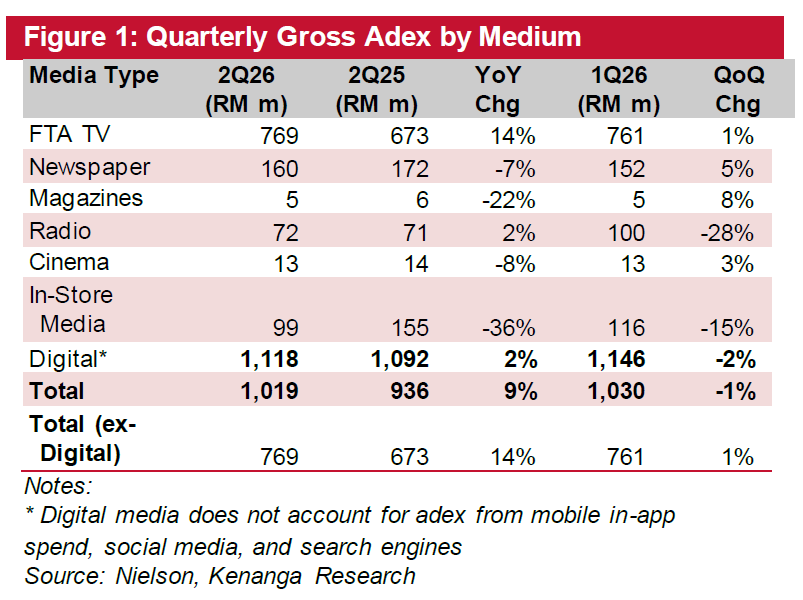
Digidex remained under pressure, with YouTube adex contracting 40% YoY in 1HCY26, marking its 11th consecutive quarter of decline.
Kenanga believes the weaker figures do not necessarily reflect a similar decline in YouTube’s underlying advertising performance.
Instead, advertisers are increasingly directing their budgets towards YouTube’s mobile and smart TV applications, in line with changing consumer viewing habits.
A growing share of YouTube’s advertising inventory is also not captured by Nielsen Malaysia, whose measurement primarily covers display and video advertisements viewed through desktop and mobile web browsers.
As in-app advertising is excluded from Nielsen’s data, the reported figures may therefore underestimate YouTube’s actual monetisation performance.
Despite this, Kenanga expects the digital advertising segment to continue facing stiff competition from social media, search and live commerce platforms.
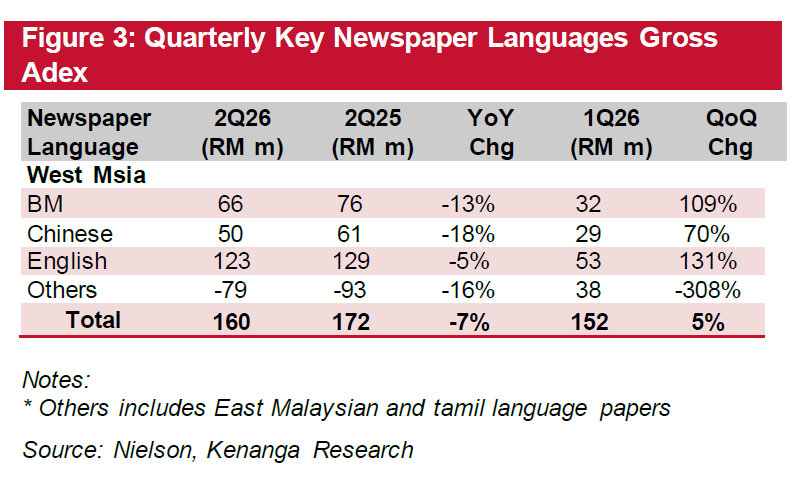
Kenanga retains their 2026 YOY adex forecast of RM4.24 bil (-9.5%), reflecting continued softness across key segments, including FTA TV (-8.6%), newspapers (-5.6%), magazines (-6.6%), radio (-8.7%), cinema (-23%), and digidex (-17.3%).
Malaysia’s traditional media industry is expected to remain under pressure as the structural shift towards digital platforms continues to reshape the advertising landscape.
Meta, Google and TikTok are increasingly capturing most of the growth in advertising expenditure, leaving free-to-air television, newspapers, radio and print media to compete for a much smaller share of the market.
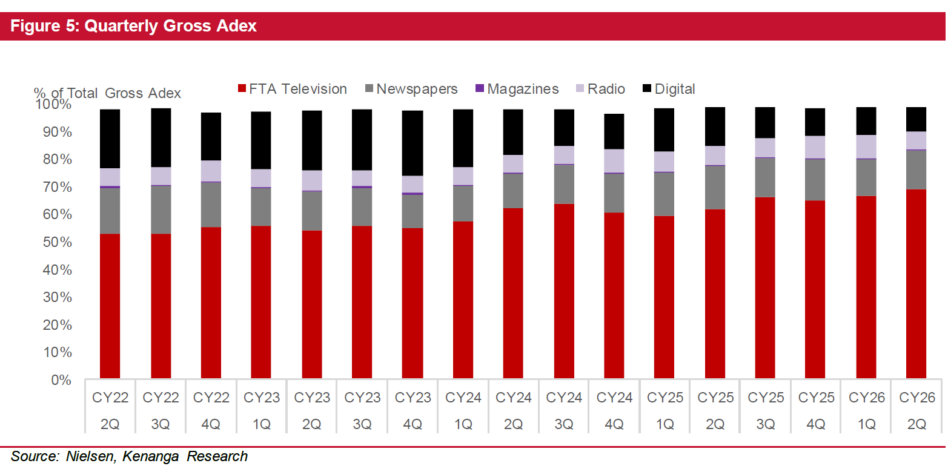
Among the key challenges facing traditional media companies is the continued diversion of advertising budgets to digital-first platforms.
The loss of World Cup broadcasting rights is another setback, particularly as major sporting events have traditionally helped media companies attract and retain subscribers.
At the same time, many traditional broadcasters continue to carry substantial fixed costs associated with maintaining legacy infrastructure.
While monetising intellectual property (IP) could offer media companies involved in film and content production a potential avenue for diversification, the strategy is unlikely to make a meaningful contribution to earnings in the near term.
Given these challenges, Kenanga has maintained its Underweight call on the media sector and does not have any preferred stocks.—Aug 17, 2026
Main image: e-spincorp.com