
MALAYSIA’S food security has improved, but structural dependence on imported food and agricultural inputs continues to leave the country exposed to external shocks, according to MBSB Research.
The report warns that the immediate impact of the US-Iran conflict on Malaysia’s food supply may be manageable, but the bigger risk could emerge in 2027.
Higher energy, fertiliser, animal feed, freight, insurance and packaging costs could gradually feed into agricultural production, potentially resulting in lower yields, tighter supply and higher food prices.
Climate change, extreme weather, export restrictions and currency volatility could further amplify these pressures.
Malaysia remains relatively well supplied in palm oil, chicken and eggs, but is more vulnerable in rice, beef, mutton and selected vegetables.
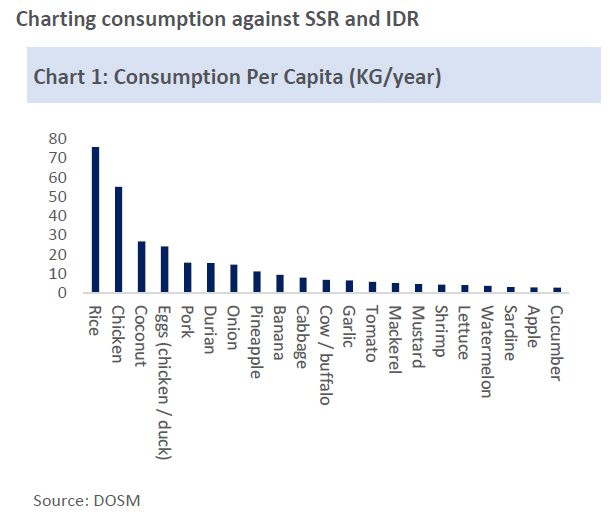
Malaysia’s food imports have risen substantially, from around RM42 bil in 2014 to more than RM100 bil in 2025, while the food and live animals trade deficit widened from RM17 bil to RM32.1 bil over the same period.
Rice remains a particular concern, with a self-sufficiency ratio (SSR) of only 52.9% in 2024, requiring around 1.5-1.6 mil tonnes of imports annually.
By comparison, Malaysia produces more than 19 mil tonnes of palm oil annually against domestic consumption of about 3.3 mil tonnes, providing a sizeable exportable surplus.
However, higher crude oil prices could strengthen biodiesel demand and tighten the global vegetable-oil market, eventually putting upward pressure on cooking-oil prices.
Poultry also illustrates the difference between domestic production and supply-chain resilience. Chicken self-sufficiency is around 91%, while eggs are in surplus at 107%. 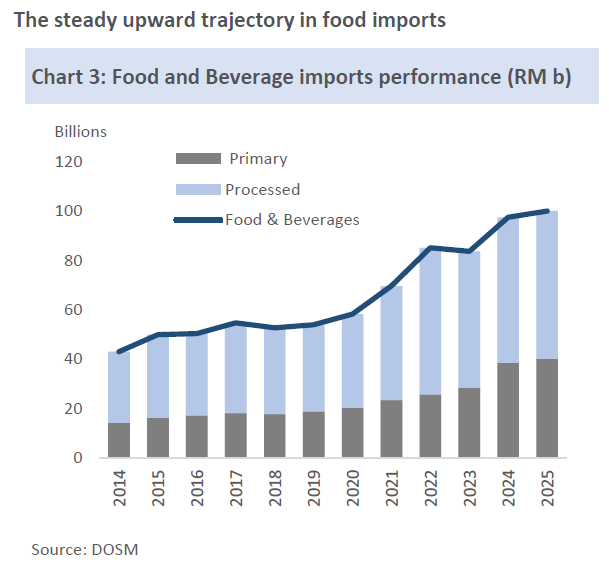
Yet Malaysia imports 99.8% of its corn and virtually all its soybean meal used for feed, exposing producers to global commodity and logistics risks.
Livestock and dairy face deeper structural challenges. Beef and mutton remain heavily import-dependent, while fresh-milk production is insufficient and milk powder is almost entirely imported.
Despite these vulnerabilities, Malaysia’s Food Security Index improved to 61.5 in 2024, driven mainly by stronger accessibility and stability. However, availability weakened to 50.0.
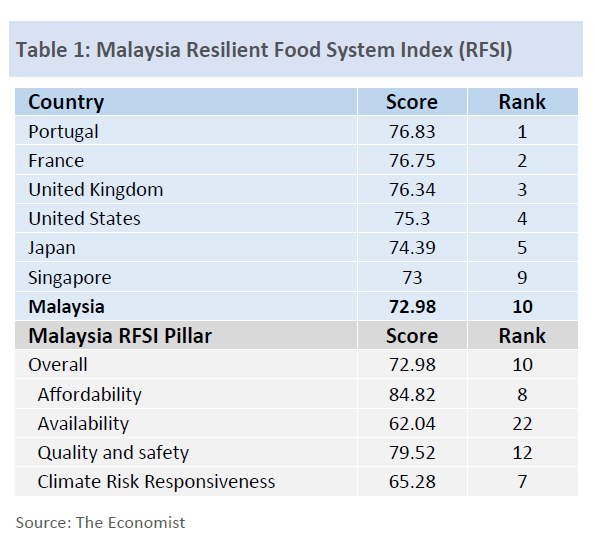
The report highlights the need to strengthen domestic production, agricultural technology, climate resilience, storage and cold-chain infrastructure, while diversifying import sources.
Overall, the key risk is that external shocks could translate into higher food costs before they result in actual shortages.—Sept 23, 2026
Main image: ajinomoto.com