

THE local construction sector is heading into 2027 with a healthy pipeline of projects, supported by stronger activity in both private developments and civil engineering works.
Construction work done rose 8.7% year-on-year to RM94.3 bil in the first half of 2026, while the Government’s RM81 bil Development Expenditure allocation for the year, including RM17.5 bil for transport, provides further support for infrastructure spending.
According to APEX Securities, the Penang LRT, MRT3 and expanding data-centre pipeline are also expected to sustain project flows, helping contractors replenish order books and maintain earnings visibility into 2027.
However, the sector’s focus next year is expected to shift from announcing projects to executing them.
Several major catalysts are likely to emerge only after Budget 2027 is tabled, with the CMC2 award expected in November and E-ART targeted for finalisation by the end of 2026.
Gamuda’s existing involvement in CMC1 and its tunnelling expertise could strengthen its position for CMC2 and MRT3.
However, the six-way competition for CMC2 and the staggered MRT3 rollout mean new orders are likely to come through progressively rather than all at once.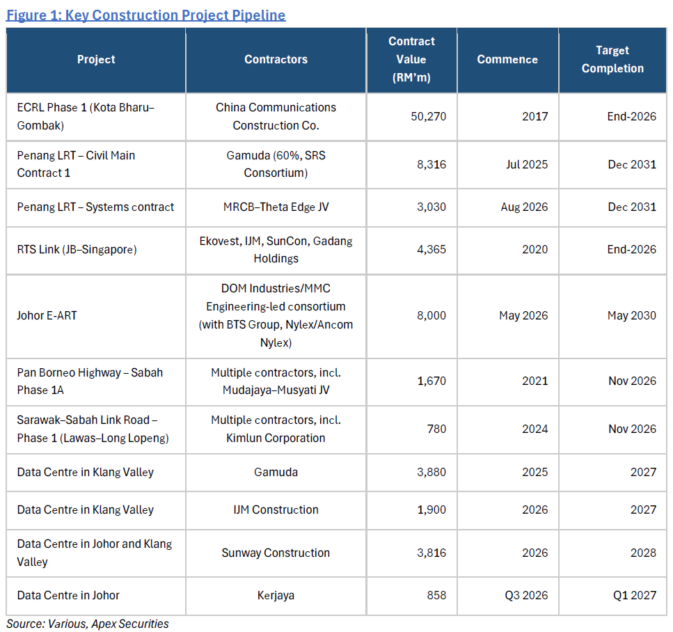
Beyond public infrastructure, data centres could provide a more sustained source of construction demand.
With 3.8GW of committed capacity still awaiting development and an estimated RM76 bil to RM95 bil in remaining contract value concentrated in Johor and the Klang Valley, the sector has a sizeable pool of projects ahead.
Contractors with expertise in power-intensive, mechanical and electrical works should continue to benefit, potentially cushioning the impact if MRT3 or E-ART timelines are delayed.
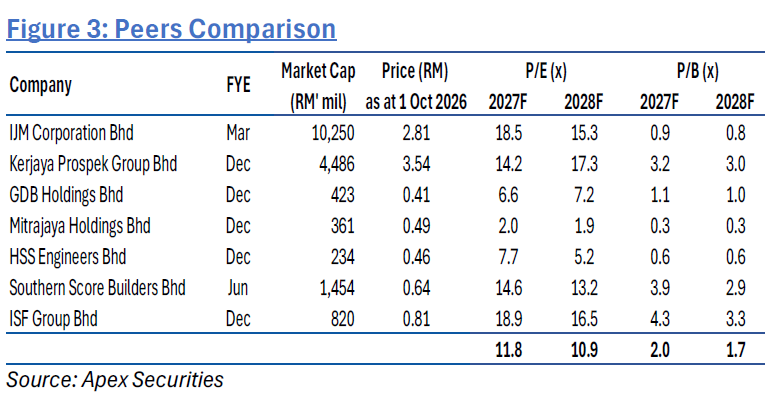
IJM and Kerjaya are positioned for larger civil, shell-and-core and fit-out packages, while ISF and SSB8 offer more specialised exposure to industrialised building systems and structural works.
HSS could benefit from growing demand for project management, engineering consultancy, design and technical oversight.
APEX Securities remarked that labour costs remain a concern. With the RM1,700 minimum wage below the RM3,100 living-wage benchmark adopted by GLICs and GLCs, Budget 2027 could potentially bring a revision to between RM1,700 and RM2,000.
Any increase would raise costs for labour-intensive contractors, particularly alongside higher EPF contributions for foreign workers.
Larger players with greater scale, automation and IBS capabilities may be better placed to manage the pressure.
Overall, the sector remains supported by infrastructure spending, improving property activity, stabilising input costs and the continuing data-centre investment cycle.—Oct 2, 2026
Main image: Market Prospects.com