
STROKE is often associated with older adults with high blood pressure, diabetes or high cholesterol. But it can also affect children, from newborns to teenagers, and recognising the warning signs can be challenging.
The Paediatric Protocols for Malaysian Hospitals, developed by the Health Ministry and the Malaysian Paediatric Association, estimates childhood stroke incidence at 2.5 to 13 cases per 100,000 children annually.
Although uncommon, paediatric stroke can be overlooked because its symptoms may resemble those of other childhood illnesses.
Dr Tan Jen Ern, consultant paediatrician and paediatric neurologist at Sunway Medical Centre Velocity (SMCV), said Malaysia did not have comprehensive national incidence data, and he encountered about one to two cases annually in his clinical practice.
“Paediatric stroke is rare, but rarity does not mean it cannot happen. The important message is to recognise sudden neurological changes and seek emergency assessment promptly,” he remarked.
Recognising the warning signs
Children may struggle to describe their symptoms, while signs can vary according to age. Older children and teenagers may develop facial drooping, weakness on one side of the body or difficulty speaking. In babies and toddlers, symptoms may include seizures, feeding difficulties or abnormal muscle tone.
“Unlike adults, children often cannot describe exactly what they are feeling, and many other childhood conditions can look like a stroke. Adding to that, a general lack of awareness among both parents and healthcare professionals can make paediatric stroke easily be overlooked,” Dr Tan said.
He advised parents to note when their child was last known to be well, as this information could help doctors determine appropriate treatment options.
“Parents should note the time when the child was last known to be well, because the timing of symptoms can be important in determining emergency treatment options,” he continued.
“Calling an ambulance allows the emergency system to help coordinate the appropriate destination and facilitate transfer to a facility with stroke expertise.”
Prompt assessment is essential, as some hospitals may need to transfer patients to facilities with the necessary imaging capabilities and specialist expertise.
Why children have strokes
Unlike adult stroke, which is often associated with lifestyle-related risk factors, childhood stroke can be linked to heart disease, abnormalities of the brain’s blood vessels, blood disorders, infections, inflammation, trauma and genetic or metabolic conditions.
“In most cases, these children have an underlying condition that has yet to be identified. In my practice, the most common underlying cause is an abnormality of the brain’s blood vessels,” Dr Tan said.
Investigations may include blood tests, screening for clotting disorders where indicated, an electrocardiogram (ECG), an echocardiogram and brain imaging, including magnetic resonance angiography (MRA), which maps blood vessels.
Treatment depends on the type and cause of the stroke. Initial care focuses on stabilising the child, controlling seizures and managing complications.
Medication to prevent further clotting may be used in selected cases, while endovascular thrombectomy, a minimally invasive procedure to remove a clot, may be considered for eligible children at suitably equipped centres.
The Malaysian paediatric protocols estimate that 12% to 20% of childhood arterial ischaemic strokes, caused by blocked arteries, recur. Dr Tan said recurrence risk varied according to the underlying cause, making investigation, treatment and specialist follow-up important.
Recovery goes beyond physical health
The effects of childhood stroke can extend beyond physical disability, affecting memory, attention, communication, learning and emotional wellbeing.
A Malaysian study published in Brain and Development in 2025 examined 76 children who had been followed up for at least two years after stroke.
About 75% had good neurological outcomes, while 72.4% had good functional outcomes. However, their health-related quality-of-life scores remained significantly lower than those of healthy Malaysian children, particularly among those with learning disabilities.
Dr Tan said some difficulties might become apparent only when children entered school and faced greater developmental and academic demands.
Long-term follow-up may therefore include physiotherapy, occupational therapy, speech and language therapy, neuropsychological assessment and educational support.
Parents should seek immediate medical attention if a child suddenly develops one-sided weakness, facial asymmetry, difficulty speaking or an unexplained seizure.
Early recognition and treatment, followed by appropriate rehabilitation, can help support the child’s development and quality of life.
Public event on brain health
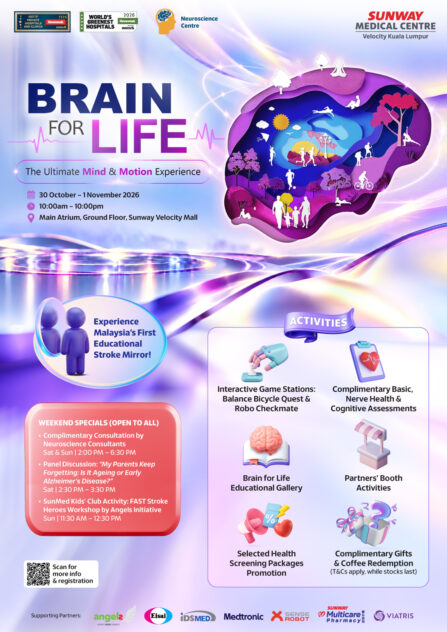
SMCV will host “Brain for Life: The Ultimate Mind & Motion Experience” from Oct 30 to Nov 1, 2026, at the main atrium on the ground floor of Sunway Velocity Mall, Kuala Lumpur. The event runs from 10am to 10pm daily.
Activities include a children’s FAST Heroes stroke-awareness workshop, interactive games, panel discussions on memory loss and early Alzheimer’s disease, complimentary consultations with neuroscience specialists, health assessments and selected screening-package promotions.
SMCV also says visitors can experience Malaysia’s first educational Stroke Mirror, which simulates stroke-related symptoms for awareness purposes and is not a diagnostic tool. ‒ Oct 16, 2026
Main image: Pexels/Muziyan Du