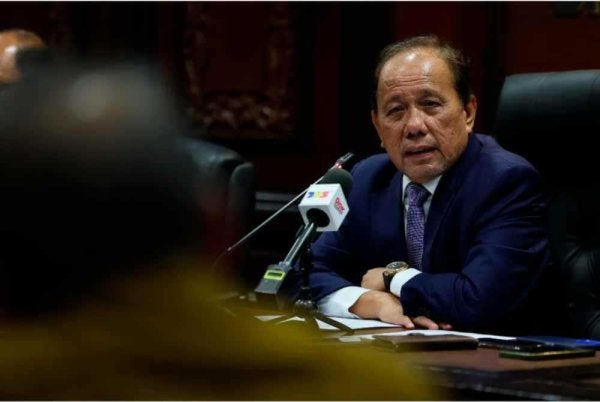

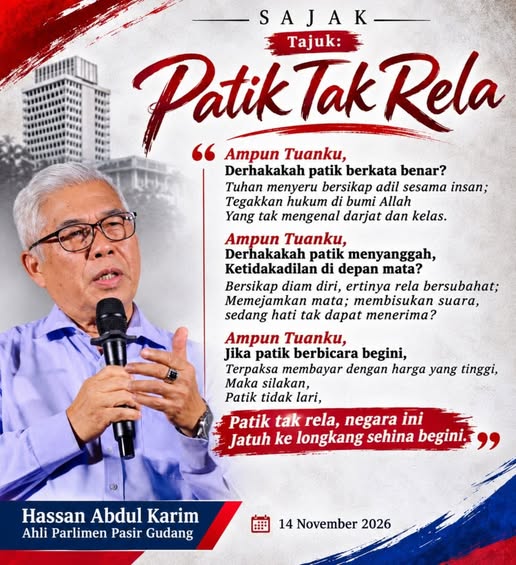
HASSAN ABDUL KARIM, the Member of Parliament for Pasir Gudang, was called to Bukit Aman on 16 November 2026 over his poem, Patik tak Rela. Media reported that the investigation is under section 4(1) of the Sedition Act 1948 and section 233 of the Communications and Multimedia Act 1998. The police have a duty to investigate reports made to them. I make no comment on the investigation.
I write as a lawyer, with full respect for Seri Paduka Baginda Yang di-Pertuan Agong (YDPA) and for our constitutional monarchy. I do not question the validity of any pardon granted to date.
My subject is the wording of Article 42 of the Federal Constitution. I raise it so that Parliament may consider amending it under Article 159.
Article 42 has two different provisions on pardons. One applies to offences committed in the Federal Territories (FTs). The other applies to offences committed in the States.
For offences committed in a State, Article 42(4)(b) provides that the Ruler or Yang di-Pertua Negeri shall exercise the power of pardon “on the advice of a Pardons Board constituted for that State”. On the text, the Ruler acts on that advice.
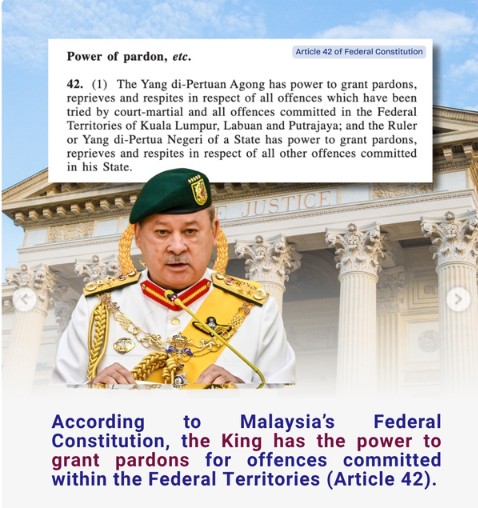
For offences committed in the FTs, the text is different. Article 42(4)(a) places the YDPA’s power under Article 40(3). That clause allows Parliament to pass a law requiring the YDPA to act after consultation with, or on the recommendation of, a person or body other than the Cabinet. A Pardons Board is one example.
Parliament has passed no such law. Instead, Article 42(11) constitutes a Pardons Board for the FTs and applies Clauses (5) to (9) to it. Clause (4)(b) is left out. The collective effect is that the FT Pardons Board will tenders advice, and nothing in the text requires His Majesty to follow it.
The pardon process therefore differs, on the wording of the Constitution, according to where the offence was committed. I believe this is an accident of drafting, and it deserves Parliament’s attention.
Najib’s judicial review application over the “Addendum Order” illustrates the point. His offences were committed in Kuala Lumpur. The Early Release Order of 29 January 2024, reproduced in the High Court judgment ([2026] 2 MLRH 387), records that the Board advised that he serve the balance of his sentence. His Majesty the 16th YDPA then reduced the sentence and the fine. On the present wording, that was within His Majesty’s power.
The confusion
Confusion arose in Attorney General of Malaysia v Dato’ Sri Mohd Najib [2025] 6 MLRA 155. The Federal Court said that the YDPA is required to act on the FT Pardons Board’s advice “pursuant to art 42(4)(b)”. With the greatest respect, I believe this was in error. That clause refers only to a Ruler or Yang di-Pertua Negeri of a State.
The case was remitted to the High Court. In Dato’ Sri Mohd Najib v Menteri Dalam Negeri [2026] 2 MLRH 387, the High Court held that a decision on clemency must be made at a meeting of the Board, after the Board has tendered its advice (paragraphs 46 and 47). However, the judgment does not say the advice must be followed.
The courts have described the power of mercy as an “executive power”. See paragraph 29 of the same High Court judgment and Public Prosecutor v Soon Seng Sia Heng [1979] 1 MLRA 384. Under Article 40(1) and (1A), executive functions are ordinarily exercised on advice, and that advice is to be accepted.
This matters for the protection of the YDPA. When a decision is seen as His Majesty’s personal decision, public disagreement with the decision – like what happened to MP Pasir Gudang – is easily read as disrespect to the institution. That is unfair to the institution and to citizens. Where advice is binding, responsibility rests with the advisers, and they answer to Parliament and the public. The YDPA as an institution remains above political controversy.
Proposed changes
For these reasons, I respectfully propose three changes: –
(a) Amend Article 42 so that the power of pardon for FT offences is exercised on the advice of the FT Pardons Board, in the same words that apply to the State Rulers.
(b) State how the Board arrives at its advice.
(c) Require the Minister responsible for the FTs to answer to Parliament for that advice.
The Board’s composition should remain as it is i.e. the Attorney General, the Minister and up to three members appointed by His Majesty. I note that there are other proposals have been made on the composition of the Pardons Board, and I respectfully differ from both. My reasons are as follows: –
(a) The Constitution (Amendment) (No. 2) Bill 2026 proposes replacing the Attorney General with the Public Prosecutor. I disagree because the Public Prosecutor’s office secured the conviction so it should not also advise on whether mercy is shown.
(b) The Malaysian Bar has proposed removing the Attorney General and the Minister from the Board. If mercy is an executive power, a politically accountable person must sit on the Board and take responsibility for its advice.
This proposal takes nothing from the dignity of the YDPA because the same wording has long applied to the State Rulers. There is no reason why offences committed in the FTs should be treated differently than offences committed in Johor or Kelantan. My proposal asks only that one standard apply throughout the Federation, stated clearly in the Constitution.
I offer these views respectfully and welcome correction. Daulat Tuanku. – Nov 17, 2026.
Lau Yi Leong is a practising lawyer in Johor. He was BERSAMA’s candidate for Johor Jaya during the Johor state polls held on July 11, 2026.
The views expressed are solely of the author and do not necessarily reflect those of Focus Malaysia.
Main image credit: Facebook/Hassan Karim