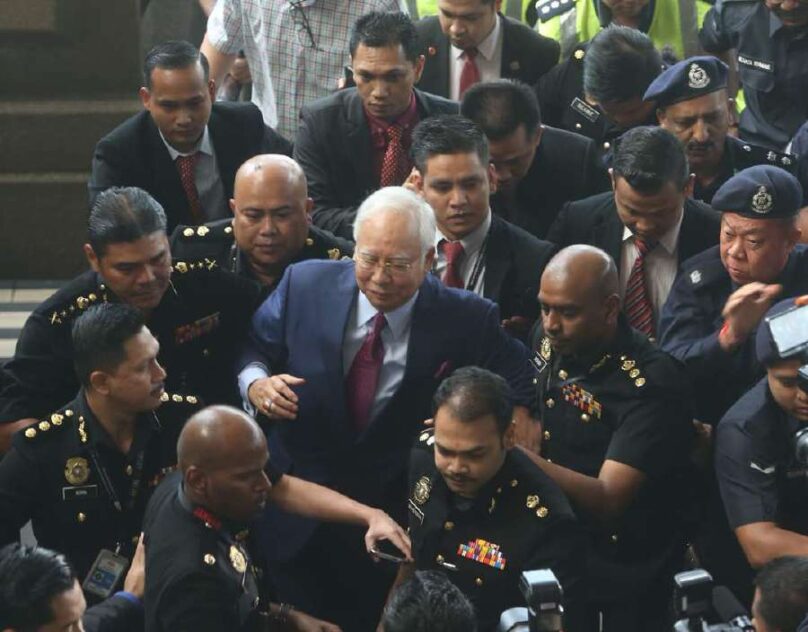

Editor’s Note: Human rights activist and lawyer Siti Kasim penned this interesting observation just hours before it was revealed that incarcerated former premier Datuk Seri Najib Razak’s bid for a pardon of his convictions linked to the 1MDB scandal will be heard at the next meeting of the Federal Territories Pardons Board (FTPB).
The legal affairs division in the Prime Minister’s Department said His Majesty Sultan Ibrahim, King of Malaysia who chaired yesterday’s (Sept 11) meeting has consented to defer the application to the next meeting.

Even though the outcome is already known, Siti Kasim’s view on whether Bossku deserves a clemency or house arrest at least in the near future is still very relevant.
TODAY, Sept 11, the Federal Territories Pardons Board is reportedly expected to discuss Najib Razak’s pardon application, including the possibility of him serving the remainder of his sentence under “house arrest”. It is uncertain whether a decision will be reached today (yesterday, Sept 11).
- I respect the power of pardon
I respect the power of pardon under Article 42 of the Federal Constitution. However, respecting the institution does not mean the public must remain silent regarding the implications of a decision.
Powers that are constitutionally valid can still be evaluated in terms of fairness, reasonableness and the public interest.
- Najib is not a victim of persecution without due process
Najib was not imprisoned merely due to political allegations.
He underwent a trial, was granted the right to defend himself and exhausted his appeals up to the highest level. His conviction in the SRC case involving RM42 mil was upheld by the Federal Court.
Therefore, do not portray him as a prisoner who never received justice.
- He has already received a massive reduction
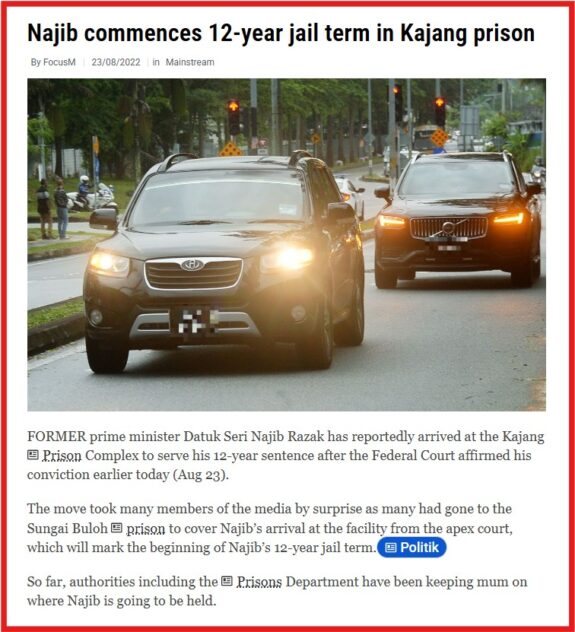
Najib’s prison sentence was reduced from 12 years to six years. His fine was also reduced from RM210 mil to RM50 mil.
Now, a new application for a pardon or house arrest has emerged. How many more “discounts” are needed before the sentence loses all meaning?
- House arrest for the wealthy is not imprisonment
A luxury home is not a prison cell.
At home, Najib can enjoy the company of his family, his choice of food, staff, comfort, privacy and various amenities never enjoyed by ordinary prisoners.
Do not use the word “detention” to mask the fact that this constitutes special treatment.
- If house arrest is a good idea, apply it fairly to everyone
If the government truly believes in house arrest as a rehabilitative policy, it should table clear legislation.
Extend equal consideration to:
- Elderly prisoners;
- Terminally ill prisoners;
- Single mothers;
- Minor offenders;
- Non-violent prisoners; and
- Those who have served the majority of their sentences with good conduct.
Do not invent the concept of house arrest only when the prisoner is a former premier who still wields political influence.

- Serious legal questions arise
The High Court previously ruled that the alleged house arrest addendum was unenforceable because the matter had not been considered by the Pardons Board during the relevant meeting.
Najib subsequently withdrew his appeal.
If the Pardons Board now makes a new decision, it might rest on a different constitutional basis. However, what is legally permissible is not necessarily fair, proper or beneficial for the country.
- What message does this send to the judiciary?
Judges, prosecutors and investigating officers spent years handling this case.
Thousands of pages of documents were examined. Witnesses were called. Arguments were heard across various levels of the court system.
If a sentence that has been handed down is ultimately eroded bit by bit due to political pressure, what message does that convey to them?
Do courts impose sentences only for politics to grant a discount?
- What message does this send to civil servants and the public?
If ordinary people steal, they go to jail. If the poor fail to pay fines, they may face longer imprisonment.
Yet, when a highly powerful individual is convicted of offenses involving public funds, they might secure a reduced sentence, a reduced fine and eventually, house arrest.
That is what a two-tier justice system looks like.

- The money involved belongs to the rakyat
The SRC and 1MDB funds are not UMNO’s money. They are not Najib’s money. It is not the money of any political family.
The money belongs to the rakyat.
The people bear the debt, the damage to the nation’s reputation and the repercussions of the scandal. That is why this matter is not merely about compassion for a single individual.
What about compassion for the people who are forced to bear the consequences?
- A pardon is not an automatic right
A pardon is an act of mercy, not a right to which a prisoner is entitled. If this new application is considered, the public has the right to ask:
- What exceptional circumstances justify Najib receiving a second pardon?
- Has he shown remorse?
- Has he accepted responsibility?
- Has the money been fully recovered?
- Has he assisted the nation in recovering lost assets?
- Why should his interests supersede the interests of public justice?
Without convincing answers, the pardon would appear not as an act of mercy but as a reward for political power.

- Do not draw simplistic comparisons with Anwar
Najib’s supporters might say, “Anwar received a pardon too.”
However, every application must be evaluated based on the facts, the history of the prosecution, the nature of the conviction, the grounds for the pardon and the public interest.
The pardon of one individual does not create an automatic right for all other politicians to receive one.
“Others have been pardoned” is not a valid reason to set aside the sentence of an individual whose conviction has been upheld by the apex court.
- The Madani government will lose its credibility
This government speaks of reform, good governance and combating corruption.
If the government yields to pressure from UMNO to safeguard its political standing, then its reformist slogans become nothing more than campaign rhetoric.
One cannot speak of eradicating corruption one day, only to help a convicted corrupt figure secure preferential treatment the next. – Sept 12, 2026
Main image credit: New Straits Times