

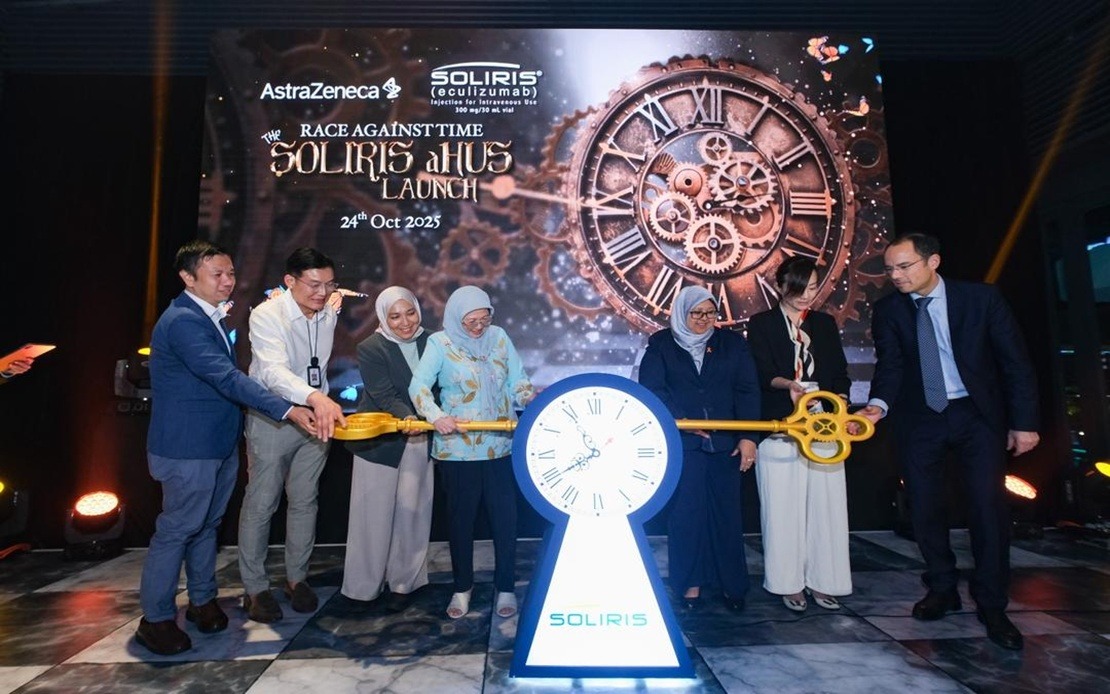
ASTRAZENECA has brought its rare disease treatment, Soliris, to Malaysia, expanding care options for patients with rare neurological autoimmune conditions and severe blood disorders.
In a statement, the biopharmaceutical company said Soliris has improved clinical outcomes in conditions such as generalised myasthenia gravis (gMG), neuromyelitis optica spectrum disorder (NMOSD), atypical haemolytic uraemic syndrome (aHUS) and paroxysmal nocturnal haemoglobinuria (PNH).
The therapy targets the complement system, a key part of the immune response, by blocking the C5 protein in the terminal pathway, helping to curb excessive immune activity linked to these diseases.
AstraZeneca Malaysia country president Svetlana Yanchuk said the introduction of Soliris reflects the company’s continued commitment to patients with rare diseases.
“With Soliris, we are advancing efforts in Malaysia to transform the lives of patients and their families, helping them live more meaningful lives,” she was quoted as saying by Bernama.
She said AstraZeneca, through its subsidiary Alexion, acquired in 2021, is leveraging insights into the complement pathway to develop treatments for rare diseases.
“We remain committed to strengthening our leadership in this space and advocating for the rare disease community, with next-generation treatments in the pipeline,” she continued.
The company noted that rare diseases are often difficult to diagnose, with patients frequently facing delays, repeated testing and misdiagnosis before receiving proper treatment.
Globally, about 300 million people live with rare diseases, many of which are serious, chronic and progressive. In Malaysia, 491 rare diseases had been recorded as of 2020, though many cases remain undiagnosed.
Meanwhile, consultant haematologist at Hospital Umum Sarawak Dr Chew Lee Ping said aHUS and PNH are linked to immune system abnormalities affecting the blood.
“aHUS is caused by immune dysregulation that can damage the kidneys, while PNH is a rare, chronic and potentially life-threatening disorder in which red blood cells break down prematurely, leading to blood clots,” she remarked.
Consultant neurologist at Sunway Medical Centre Dr Hiew Fu Liong said gMG and NMOSD affect the nervous system and can lead to serious complications.
“gMG is a chronic autoimmune neuromuscular disease that often begins with weakness around the eyes before progressing to the head, neck, limbs and respiratory muscles,” he noted.
He added that NMOSD is a rare, debilitating condition affecting the central nervous system, particularly the optic nerves and spinal cord, and can lead to vision loss, paralysis and other neurological complications. ‒ March 19, 2026
Main image: AstraZeneca via Bernama