
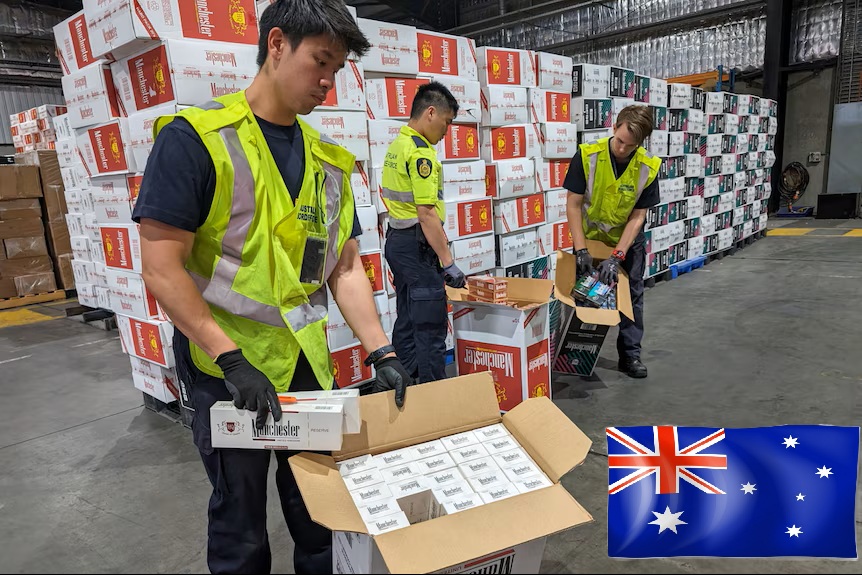
AUSTRALIA’S illicit cigarette market now accounts for an estimated 55% of total consumption, according to the country’s Illicit Tobacco and E-cigarette Commissioner (ITEC). – a figure that is almost identical to Malaysia’s own illicit incidence of 54.4%.
A Nikkei Asia report recently painted a stark picture of a country whose aggressive anti-tobacco taxation policies have inadvertently fuelled a booming black market, gang-linked violence and the possibility that smoking rates may rise for the first time in decades.
For Malaysia, the parallels are difficult to dismiss.
According to the Nikkei Asia report, the Australian illicit trade is valued at between A$4 bil and A$7 bil (RM12 bil to RM21 bil) with potential lost tax revenue of A$11 bil (RM33 bil). Organised crime groups have moved in to fill the gap created by soaring legal cigarette prices which now average around AU$50 (RM150) per pack.
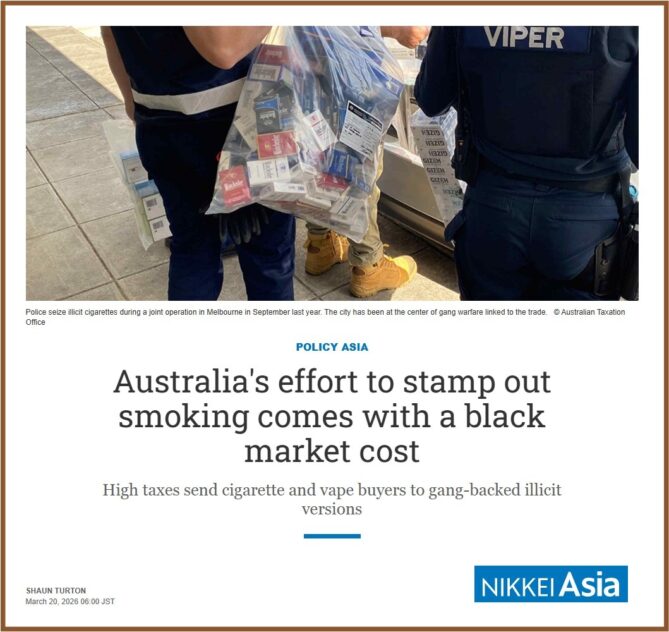
Since January 2023, there have been 275 arson attacks on tobacco retailers linked to criminal syndicates battling for control of the trade, resulting in eight deaths. Melbourne, Australia’s second largest city, has been the focal point of what one local businessman described as a “tobacco war.”
Convenience chain 7-Eleven Australia saw tobacco decline from 40% of its total merchandise sales prior to its acquisition by Japan’s Seven & i Holdings in April 2024 to just 8% today – a collapse driven not by fewer smokers but by consumers shifting to illicit, untaxed products sold at a fraction of the legal price.
No better off in Malaysia
Public health experts cited in the report expressed concern that the Australian Bureau of Statistics’ forthcoming triennial household survey may show an increase in smoking prevalence for the first time in decades.
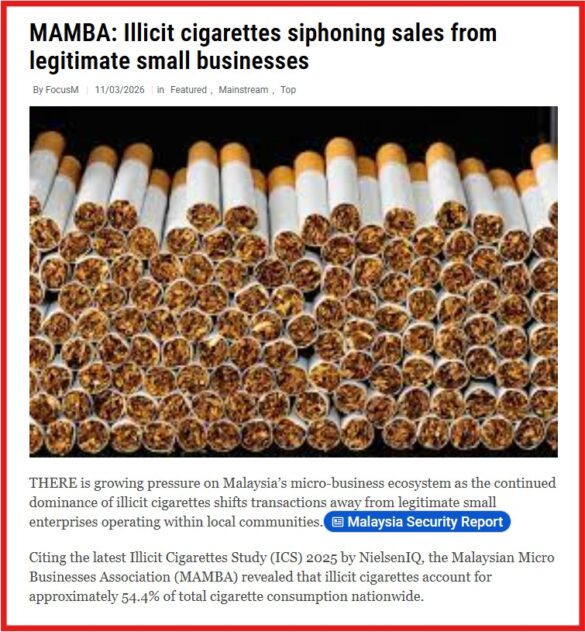
The Malaysian context is uncomfortably similar. The latest NielsenIQ Illicit Cigarettes Study (ICS) 2025 found that illicit cigarettes accounted for 54.4% of total consumption, a marginal improvement of just 0.6 percentage points compared to 2024.
In Sabah, the illicit incidence stands at 77.3%. In Sarawak, it is 78.8%.
The Confederation of Malaysian Tobacco Manufacturers (CMTM) has also flagged a rising concern over cigarettes bearing fake tax stamps (FTS) with national FTS incidence increasing by 1.7 percentage points year-on-year (yoy) and wider penetration reported in Johor, Penang, Melaka, Terengganu and Kelantan.
The price gap remains the fundamental driver. A legal pack of cigarettes in Malaysia now costs around RM18.40 following the excise duty increase under Budget 2026 – the first such hike in a decade.
On the contrary, illicit packs are available for as little as RM3, according to the Malaysian Micro Businesses Association (MAMBA) which has warned that the distorted market threatens sundry shops, kopitiam and neighbourhood kiosks that comply with licensing and taxation requirements.
In Australia, the illicit trade has ignited a policy debate over whether the government should continue raising tobacco taxes or freeze or lower rates to undercut the black market.
One Australian criminologist was quoted in the Nikkei Asia report as arguing that it is no longer the government setting the minimum price of tobacco but organised crime groups and that further tax increases would be counter-productive.
View this post on Instagram
Learn from Australia’s policy mismatch
Others, including public health academics, have pushed back, arguing that the focus should remain on helping smokers quit entirely through investment in cessation support, public health campaigns and smoke-free infrastructure rather than making legal cigarettes more affordable.
Malaysia faces a similar tension. The government’s allocation of RM700 mil under Budget 2026 for enforcement and digitalisation, including digital tax stamps and enhanced screening systems, signals awareness of the scale of the challenge. Enforcement authorities have recovered an estimated RM15.5 bil over the past two years.
The cross-border dimensions of the illicit trade add a further layer of complexity. The Nikkei Asia report identified Southeast Asia as a source of supply for Australia’s illicit market, noting that declining smoking rates in the region have left tobacco growers with excess capacity that is being channelled into illicit channels.
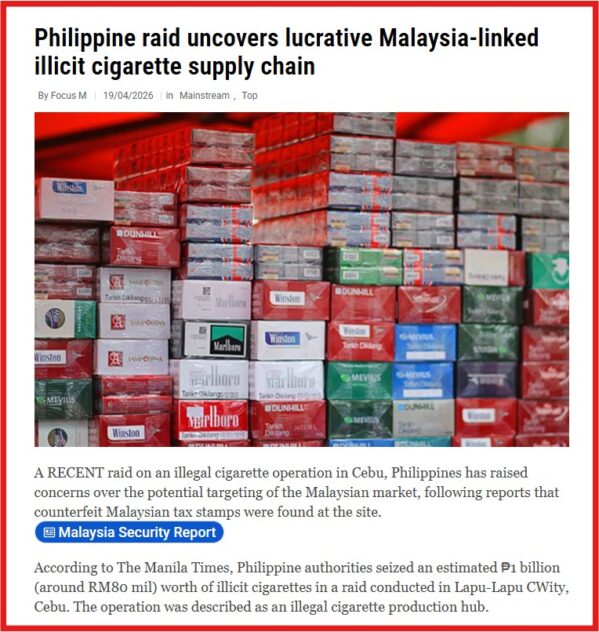
A separate FocusM report earlier this month highlighted a Philippine raid that uncovered an illicit cigarette operation in Cebu bearing counterfeit Malaysian tax stamps with Malaysia identified as one of the intended destinations.
These developments underscore the regional nature of the challenge and the limits of purely domestic enforcement responses.
Australia’s experience suggests that high taxation – while effective at reducing smoking rates in the short term – can produce diminishing returns if the resulting price gap is not matched by enforcement capacity and demand-side interventions.
With Malaysia’s illicit market share now virtually identical to Australia’s – and with structural vulnerabilities including long coastlines, porous borders and regional price disparities firmly in place – the policy lessons from Australia are directly relevant.
The question is whether those lessons will be acted upon before the parallels deepen further. – April 23, 2026
Main image credit: ABC News