


THE 2027 Budget proposes federal expenditure of RM459.8 bil, up 9.7% from RM419.2 bil in 2026, with total spending reaching RM510 bil when contributions from government-linked investment companies (GLICs), government-linked companies (GLCs) and other state-owned bodies are included.
According to Public Investment Bank (PIB), the budget aims to improve household welfare, promote equitable wealth distribution and support high-value economic growth while maintaining fiscal discipline.
Despite geopolitical tensions and inflationary pressures, Malaysia’s economy is projected to grow by 4.2% to 5.2% in 2027, compared with 4.8% to 5.3% in 2026.
The moderately expansionary budget is expected to sustain domestic demand amid a potentially weaker external environment.
GLICs, GLCs and other state-owned bodies will mobilise RM50.2 bil, down 1.2% year-on-year, to support strategic sectors.
Initiatives include a RM1.25 bil New Economy Venture Fund for data centres and logistics assets, established by Sime Darby Property, EPF and LTAT, alongside RM1.2 bil in joint semiconductor ecosystem investments by Khazanah and KWAP.
Fiscal consolidation remains a priority, with the deficit projected to narrow from 3.6% of GDP in 2026 to 3.3% in 2027.
Greater private-sector participation and co-investment arrangements are also expected to ease federal funding requirements, said PIB.
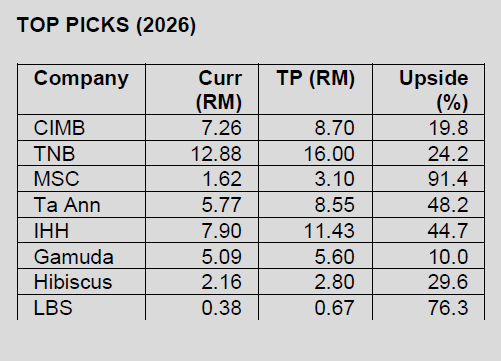
Targeted cash assistance, personal tax relief and affordability measures should support consumer spending, benefiting food and staple producers such as QL, SDS, Farm Price, CCK and Teo Seng.
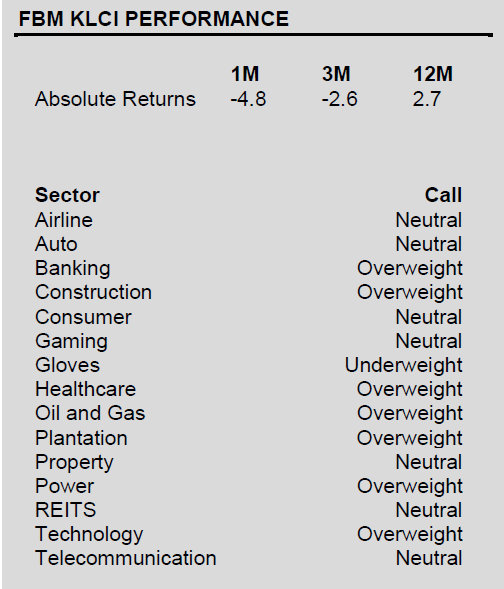
The extended Visit Malaysia campaign could boost hospitality, medical tourism and food-service businesses, including Spritzer, Life Water, Genting, IHH, KPJ and Sunway Healthcare.
MediAsas may increase private healthcare patient volumes, although lower margins could offset some gains.
PIB pointed out that construction activity is expected to remain supported by infrastructure spending, including RM15 bil for strengthening the national electricity grid, RM2.5 bil for water infrastructure, RM3.4 bil for rail upgrades, RM1.2 bil for public healthcare facility maintenance and RM16.5 bil for roads.
However, raising the minimum wage from RM1,700 to RM2,000 from June 2027 could pressure margins in plantation, construction, glove and electronics manufacturing services companies.
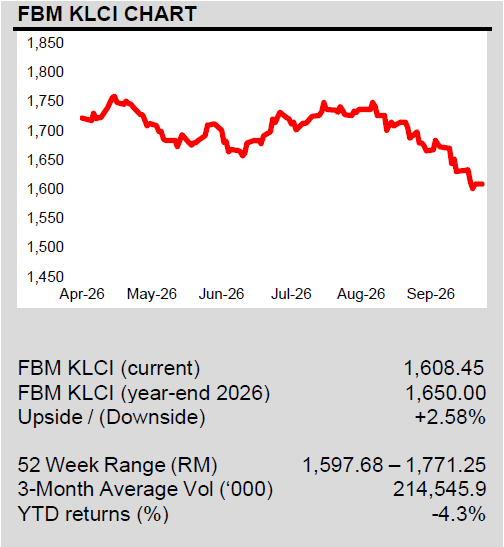
Overall, the budget’s market impact is expected to be muted as global inflation, rising bond yields and external uncertainty continue to influence equities.
Higher risk-free rates could weigh on valuations, while cost pressures may constrain corporate earnings.
The outlook favours commodity-related and domestic-focused companies capable of passing higher costs on to consumers.—Oct 12, 2026
Main image: CNA