


KENANGA maintains its Overweight rating on the healthcare sector, highlighting decarbonisation as an increasingly important operational and sustainability priority for Malaysia’s private healthcare operators.
Hospitals are energy and resource intensive, requiring continuous electricity, cooling, ventilation, sterilisation and medical supplies.
Effective decarbonisation therefore extends beyond renewable energy adoption to encompass energy efficiency, clinical emissions reduction, waste management and many more.
According to Kenanga, IHH Healthcare, KPJ Healthcare and Sunway Medical (SUNMED) have committed to achieving net zero emissions by 2050, although their strategies and disclosure maturity differ.
IHH focuses on emissions measurement, reducing anaesthetic gases and engaging suppliers. In FY2025, its market-based Scope 1 and 2 emissions intensity declined 8.2% year-on-year to 129.4kg CO₂e per patient-bed-day.
Rooftop solar installations at 13 of its 18 Malaysian hospitals generated 3,800MWh of renewable energy, while group desflurane-related emissions fell 44% against 2023 levels.
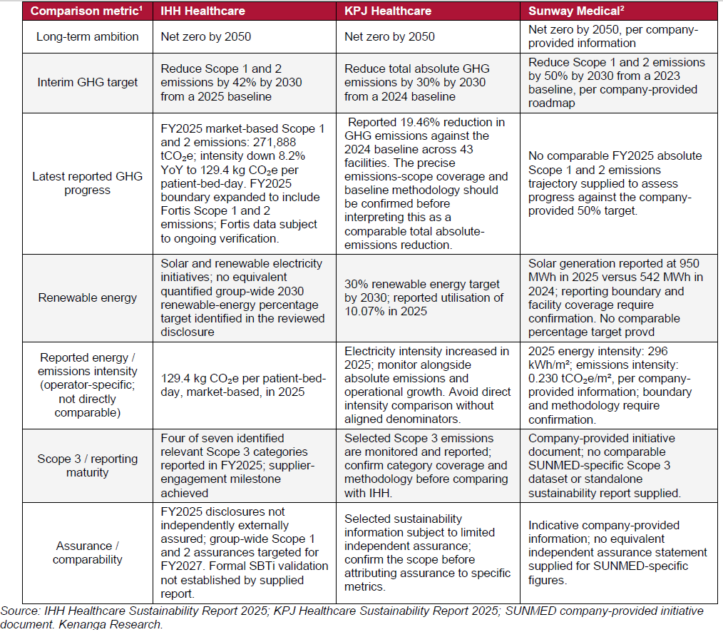
KPJ reported a 19.46% reduction in greenhouse gas emissions against its 2024 baseline across 43 facilities in 2025, alongside renewable-energy utilisation of 10.07%.
SUNMED Its reported solar generation increased to 950MWh in 2025 from 542MWh in 2024, while total waste diverted rose to 297 tonnes from 269 tonnes.
Beyond lowering environmental impact, these initiatives could help healthcare operators optimise energy consumption and resource utilisation, while supporting demand for related technologies and services.
Nevertheless, the potential financial gains will vary according to project costs, procurement requirements and practical implementation challenges.
Current disclosures also provide insufficient information to establish the overall size of the market opportunity.
From an investment perspective, greater emphasis should be placed on whether healthcare operators are making consistent, measurable progress towards their decarbonisation commitments.
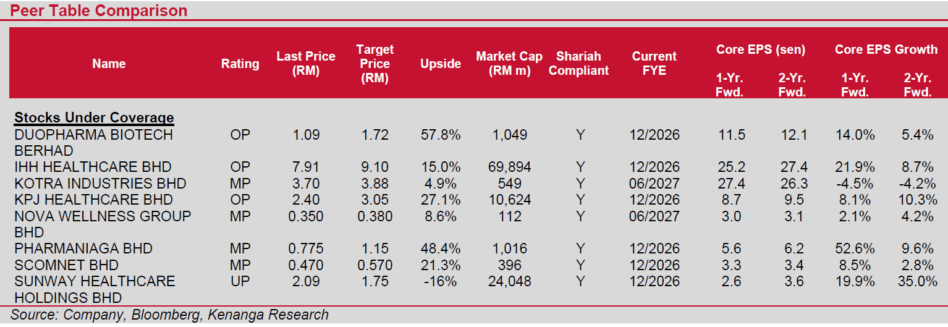
Key areas to monitor include absolute emissions reductions, improvements in energy efficiency, the adoption of renewable electricity, the extent of Scope 3 emissions reporting and the availability of independent assurance.
These indicators should be evaluated in the context of business expansion and the need to maintain patient-care standards.
Overall, Kenanga regard decarbonisation progress and reporting transparency as complementary factors in assessing operational performance and sustainability risks, rather than primary determinants of investment ratings.—Oct 21, 2026
Main image: klsescreener.com