


LARGE-SCALE raids last April, including the arrest of 133 foreign nationals in Balakong and Shah Alam, Selangor as well as a warning by Home Minister Datuk Seri Saifuddin Nasution against foreigners conducting business by abusing social visit passes or visas reflect the authorities’ determination to address a growing problem.
Foreign nationals are now part of the machinery driving the distribution of illicit cigarettes in the country; they are longer merely workers but owners of these illegal businesses.
However, the question remains: despite frequent raids and enforcement operations, the illicit cigarette market persists at 54.4% with an estimated value exceeding RM5 bil annually. Imagine a retail premise selling untaxed cigarettes, operated by foreign nationals with supply sources that are unknown.

Raids and closures only have temporary impact as operations can quickly resume. The reality is that syndicates continue to thrive due to high demand and the willingness of certain parties to take risks.
Modus operandi
Raids in Balakong and Shah Alam on April 8 demonstrated this pattern. In the operation, 133 foreign nationals were detained and illicit cigarettes were seized.
This is not an isolated case. Enforcement operations in Selangor and Negeri Sembilan in September 2025 revealed six premises raided and nine individuals detained, three of whom were Myanmar nationals running the premises – not merely working there.
Bukit Aman Criminal Investigation Department Director Datuk M. Kumar confirmed that syndicates use illegal routes to transport illicit cigarettes from neighbouring countries. A total of 4,720 cartons of cigarettes were seized.
The boldness of this modus operandi is evident from official figures. In 2025, the Royal Malaysian Customs Department (JKDM) recorded a new high in seizures of illicit cigarettes and tobacco valued at RM903 mil over a two-year period with enforcement revenue collection also reaching record levels.
Yet, the country continues to suffer losses due to the persistently high share of the illicit cigarette market.
Over the past five years, Malaysia has lost RM1.4 bil in unpaid duties while cases involving counterfeit tax stamps have increased by 1.7 percentage points compared to the previous year.
Cross border supply chain
The question is; where do the cigarettes sold at these premises come from?
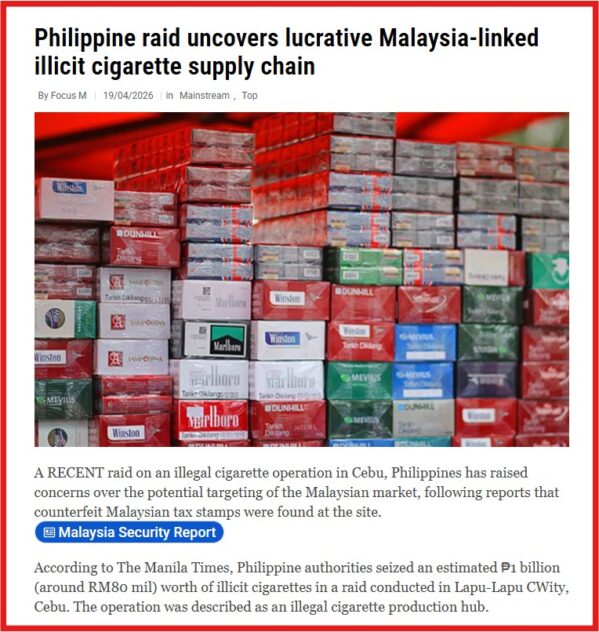
In a raid in Cebu, the Philippines last April, authorities acting on information from JKDM uncovered a factory producing illicit cigarettes worth RM80 mil with counterfeit Malaysian tax stamps.
Four Chinese nationals were arrested. Two import companies based in Kajang, Selangor which are Gillion Tobacco Sdn Bhd and Long One Trading Sdn Bhd were listed as recipients of the supply.
The Philippine National Intelligence Agency described the operation as a key node in a transnational illicit tobacco smuggling network.
Enforcement operations alone are not enough. This is given that the cost of replacing arrested distributors is far lower than the profits generated.
This activity threatens economic security and must be addressed more decisively, including through criminal prosecution (not merely seizures or compounds), immediate deportation and entry bans for foreign nationals involved.
At the same time, the level of risk for perpetrators must be increased through regional blacklisting and sustained enforcement at the retail level.
If you are aware of any premises or individuals involved in illicit cigarette distribution, report them to JKDM via the Customs Toll-Free Hotline at 1-800-88-8855 or the nearest customs office. Whistleblowers’ identities will be kept confidential.
In addition, do not purchase illicit cigarettes such as those without valid tax stamps as every purchase directly finances these criminal operations.
As long as there is a constant turnover of foreign nationals within this ecosystem, these hard-to-eradicate syndicates will continue to operate.
Cutting off the supply of manpower to this network through sustained enforcement, appropriate penalties and public awareness is the only way to change this equation. – May 7, 2026
Zaki Salleh is a defence and security analyst who has been writing in the field for over 25 years.
The views expressed are solely of the author and do not necessarily reflect those of Focus Malaysia.