
MALAYSIA’S energy transition is underway — but the harder question has never been whether to transition. It has always been how to pay for it without breaking the economics that make it viable in the first place.
As the country races toward its 2050 net-zero commitment, the energy sector faces a structural tension that no policy ambition alone can resolve: how to deploy the substantial upfront capital that clean energy infrastructure demands while preserving the return thresholds that make that capital worth deploying at all.
As Kinergy Advancement Bhd has come to understand through its own strategic evolution, decarbonisation without addressing intermittency and base-load reliability remains aspirational.
The real challenge is not choosing between cost and sustainability. It is integrating both in a way that is technically executable and commercially defensible — at the same time.
For companies that have historically operated on the engineering side of the energy value chain, this inflection point demands more than a pivot.
It demands a re-thinking of what the business was always building toward — and the discipline to execute that re-thinking without losing financial ground in the process.
Recurring income stream
Capital discipline, however, is not only expressed through partnership structures and offtake agreements. It is also embedded in technology selection — the choices made at the project level that determine whether capital intensity is manageable from day one.
Run-of-river mini hydropower where site conditions permit offers a structurally lower capital footprint than conventional hydro development by avoiding large-scale civil works while delivering reliable, renewable base-load generation.
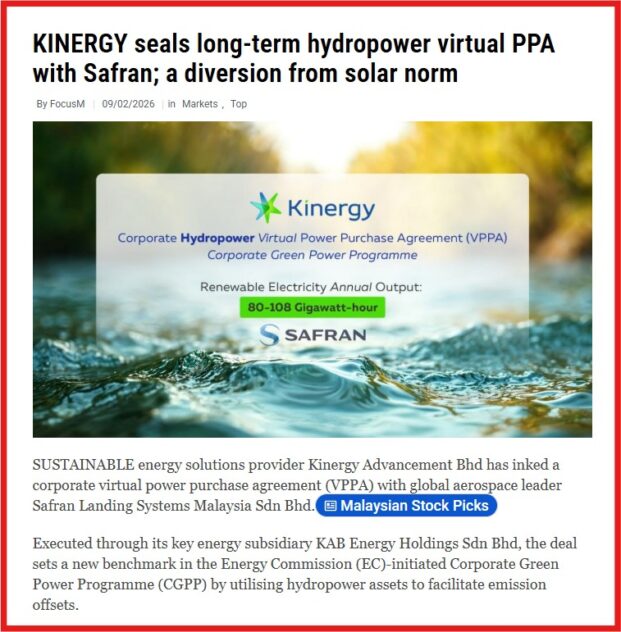
Deployed through Organic Rankine Cycle (ORC) technology, waste heat recovery (WHR) as demonstrated at Safran Landing Systems Sdn Bhd, takes a different but equally disciplined approach.
Rather than deploying new capital into new generation, it unlocks value from energy that already exists within existing industrial processes.
The outcome for the client is optimised operations and cost efficiency while the outcome for Kinergy is a recurring income stream anchored in long-term contractual arrangements.
Taken together — site selection, partnership structure, offtake certainty and technology choice — these decisions form a coherent capital discipline framework. One where the return threshold is not an afterthought but the architecture around which every project decision is made.
‘Energy transition is about integration’
Malaysia’s energy transition confronts a trilemma that no single solution resolves cleanly: ensuring grid reliability, maintaining cost efficiency and achieving decarbonisation — simultaneously at scale under commercial constraints.
Most energy players navigate this by defaulting to the most visible metric. Solar capacity expansion dominates the conversation not because it resolves the trilemma but because it is the easiest variable to optimise in isolation.
But Kinergy’s position is deliberately different. Rather than focusing on a single energy type, the group has built a diversified portfolio spanning mini hydro, biogas, waste heat recovery and solar that addresses multiple dimensions of the trilemma at once.
The logic is not diversification for its own sake. It is the recognition that a resilient energy platform cannot be built on a single variable, hence the most commercially durable positions in energy transition will belong to those who can deliver integration – not just capacity.
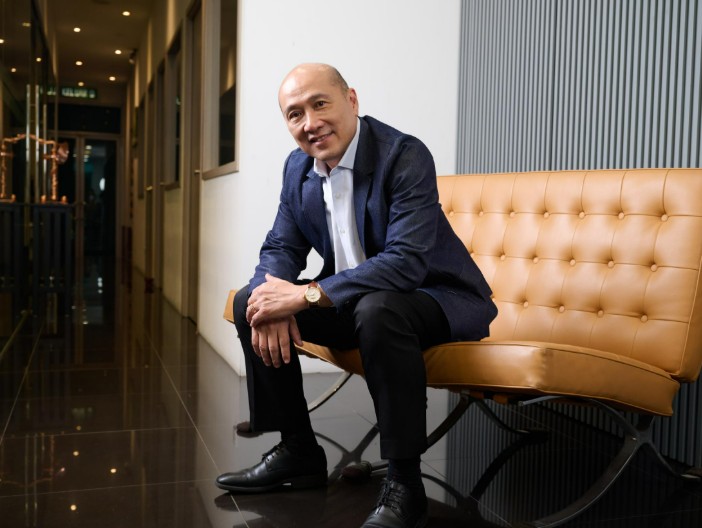
As Kinergy’s founder and group managing director Datuk Lai Keng Onn aptly put it:
The energy transition isn’t about sacrificing cost-efficiency for sustainability or vice versa.
It’s about engineering solutions that deliver both. Our diversified portfolio proves that disciplined, technically rigorous approaches can realise cost efficiency and decarbonisation simultaneously — and it is delivering promising returns to our investors.
That credibility is further anchored by Kinergy’s position as a trusted partner to PETRONAS, Malaysia’s national oil & gas corporation — having been awarded three projects, including two gas-fired power plants that serve as transition-enabling assets bridging the gap between the country’s current energy mix and its long-term decarbonisation ambitions.
The commercial validation of this integrated approach is unambiguous. Kinergy’s Sustainable Energy Solutions (SES) segment grew from RM107.8 mil or 49% of the group revenue in FY2024 to RM328.2 mil or 69% of group revenue in FY2025.
A year-on-year increase of over RM200 mil. That is not a portfolio re-balancing. That is the market confirming that integration – executed with discipline – is the right thesis.
Engineering the balance
The energy transition is not a challenge for energy companies alone. It is a challenge that lands on the balance sheets, operational structures and competitive positioning of every industrial business in Malaysia that consumes energy, manages emissions or operates within regulated sectors.
For these businesses, the question is not philosophical. It boils down to practicality: how do we reduce our carbon footprint without structurally degrading our cost position?
How do we meet increasingly rigorous regulatory and ESG (environment, social and governance) expectations without sacrificing operational reliability? How do we plan capital expenditure in an environment where energy costs, policy frameworks and technology standards are all simultaneously in flux?
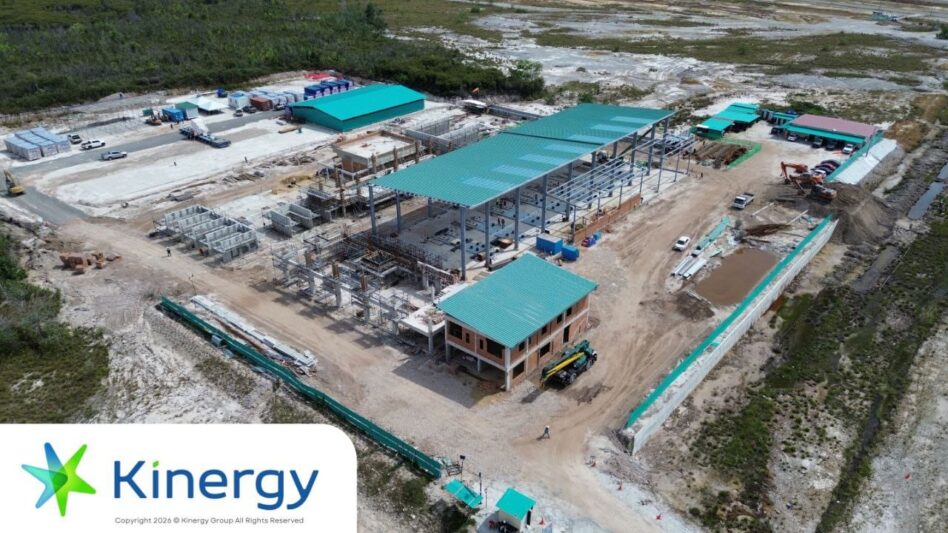
Kinergy’s integrated approach — combining engineering execution with diversified energy solutions and long-term contractual structures — is built to answer precisely those questions.
Long-term arrangements provide price stability for clients at the point where energy cost uncertainty is most damaging to planning.
Integrated solutions across solar, hydro, biogas and waste heat recovery allow the energy mix to be tailored to a client’s specific operational profile rather than applied as a one-size solution.
And an engineering-first approach ensures that technical viability and commercial sustainability are assessed together, not sequentially.
The energy transition will not be won by ambition. It will be won by those who can deploy capital efficiently, execute technically and deliver outcomes that are commercially sustainable at every stage of the journey — not just at the point of announcement.
Kinergy’s evolution from an engineering-led business into a diversified energy platform is not a story about re-invention.
It is a story about following the logic of what was always being built toward — a position in the energy value chain where engineering rigour, capital discipline and integrated solutions converge into something that is greater than any single capability alone.
As Lai who is also Kinergy’s deputy executive chairman concluded:
What gives us the confidence in that position is not just what we have delivered — the PETRONAS partnership, the RM328.2 mil SES revenue, the Safran WHR deployment, the diversified portfolio we’’ve built and refined — but where the platform is now taking us.
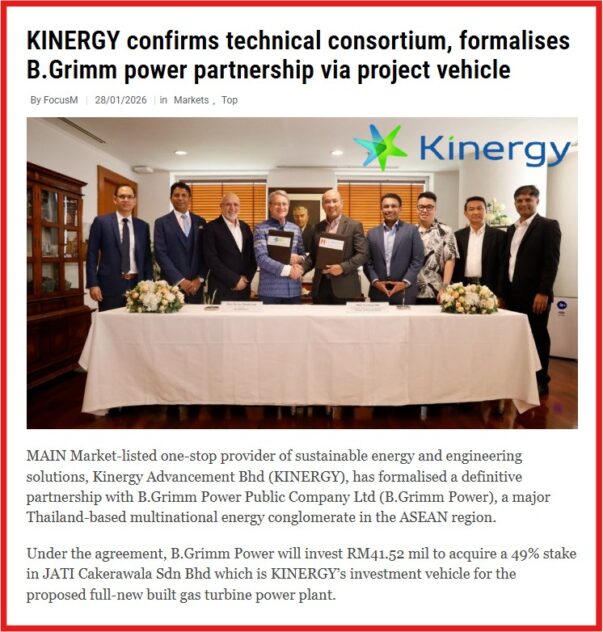
Our entry into the independent power producer (IPP) space and our technical alliance with B.Grimm, a leading ASEAN power company, marks the next deliberate step in that journey.
These are not pivots. They are the natural progression of a strategy that was never only about engineering.
The milestones — past and forthcoming — are not isolated achievements. They are the pieces of a platform coming together, one that was designed, from the beginning to be more than an engineering company.”– May 23, 2026
Main image credit: General Kinematics