
WHEN I was younger, I often felt that the future, creativity, and freedom I was searching for existed somewhere else. Travelling across Malaysia changed that completely.
The turning point came when I stopped seeing places as mere destinations and began viewing them as living stories.
I remember staying at an Iban longhouse and realising that Malaysia is not just diverse on paper; it contains worlds within worlds. You meet communities whose way of life, hospitality, and connection to the land carry something deeply meaningful, with a warmth that lingers long after you leave.
During my travels, I also encountered quieter moments that revealed another side of the country: an elderly trishaw rider in Penang still working because the pandemic had devastated his livelihood; a Chinese auntie at Chew Jetty selling ice cream in what had become a ghost town; and time spent with the Bajau Laut community, who showed how dignity and gentleness endure even in hardship.
Those moments made Malaysia feel human. Not abstract or political, but something fragile and alive, carried daily by ordinary people. I still see its flaws, but also its beauty, struggle, and coexistence. Having seen that up close, I no longer take Malaysia for granted.
For me, the journey often matters as much as the destination itself.
The destination may be the goal, but the journey gives a trip its meaning and emotional weight. How you get there—by car, train, plane, or on foot—shapes what you notice along the way. When you hike, for instance, you do not simply pass through a place; you experience it layer by layer.
Trips feel more meaningful when you have to earn them. When the journey is slower or more difficult, appreciation deepens.
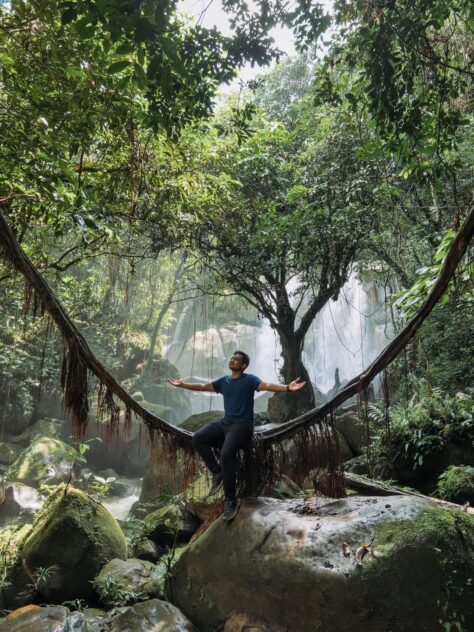
One journey I remember vividly is hiking to Air Terjun Susung in Sarawak. It was raining, and we travelled by boat through a downpour before staying overnight in a local house in the hills.
We slept on a wooden floor, wrapped in blankets, listening to the steady rhythm of rain. The next morning, we took another boat before reaching the waterfall. What stayed with me was not just the destination, but how the journey unfolded, step by step.
Travelling by train offers a different relationship with the journey compared to driving. I experienced this on trips to places like Dabong, and even on longer journeys to Bangkok. People often focus on speed, but how you travel can reshape how a destination is experienced.
From distance to discovery
The East Coast Rail Link (ECRL), expected to be operational by January 2027, will connect towns and cities along the East Coast to the West Coast of Peninsular Malaysia.
Greater connectivity will change how people plan trips. Places once considered too far for a short getaway could become realistic weekend options.
Instead of staying close to Selangor or Genting, people might start thinking about a weekend in Kota Bharu or a quick island escape along the East Coast.
As someone from the East Coast, the idea of more people discovering the region is exciting. I think of places like Kampung Mangkuk, with its quiet charm, coconut trees, and open landscapes that are often overlooked.

Besut, known as a gateway to the islands, has far more character if you take time to explore. Kuala Kemaman remains laid-back and deeply rooted in local life, where evenings are spent talking, playing games, and moving at an unhurried pace.
Beyond specific destinations, what matters is how the journey is experienced. Along older coastal roads, you pass coconut trees, roadside stalls, and small moments of everyday life that give the East Coast its rhythm.
If travel becomes more accessible, the impact could be significant. Tourism would grow, local businesses would gain visibility, and new opportunities would emerge for communities.
More importantly, it could help Malaysians see the East Coast beyond stereotypes—as a place rich in culture, food, warmth, and identity.
On a personal level, it would also change family life. With the ECRL linking Terminal Bersepadu Gombak to KotaSAS in Kuantan, the journey could take just an hour and a half. That kind of accessibility would make it easier to return home more often, allowing children to spend more time with their grandparents.
Looking ahead, domestic travel in Malaysia will likely become more frequent, flexible, and experience-driven. As travel becomes easier, the hope is that Malaysians will not just move faster, but become more open to discovering their own country.
Because for me, Malaysia is no longer just where I come from. It is a place I am proud to keep discovering. ‒ April 10, 2026
Fikri Zamri is a local content creator best known for inspiring travel content, capturing cinematic and stunning landscapes that inspire people to explore and reconnect.
The views expressed are solely of the author and do not necessarily reflect those of Focus Malaysia.
Main image: Unsplash/Simon Wiedensohler