


ACCORDING to the Oxford University Press, rage bait is defined as online content deliberately designed to elicit anger or outrage by being frustrating, provocative or offensive.
Unlike standard clickbait that relies on curiosity, rage bait specifically aims to annoy or anger users.
That is clearly the intention with a post by suspected cybertrooper Ilman Wafiy (@ilmn_wfiy) on Threads which made a loaded observation comparing local Chinese with their Indonesian counterparts.
It was surmised that the Indonesians were preferred because they know the value of “using Indonesian language more often in their daily lives helps them to be more accepted by the majority.”
Editor’s Note: The suspicion that the poster is a paid cybertrooper is based on the threadbare number of posts on the account, all of which seem to have the same underlying rightist tone.
View on Threads
This racist observation certainly had the desired ‘rage bait’ effect as plenty of commenters were keen to join the fray.
Of course, there were those trying to raise the heat further with deliberately provocative comments.

On the flipside was an unimpressed Indonesian Chinese who claimed that the poster was lacking in historical knowledge in making such an assertion.
It was countenanced that the national language was “forced upon” the Indonesian Chinese community. The painful lesson – “assimilation doesn’t guarantee acceptance.”
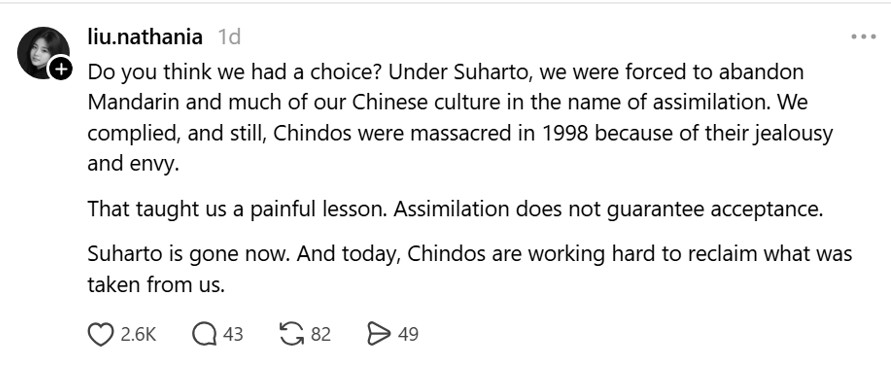
Similar tales of hardships of Indonesian Chinese was highlighted to counter the poster’s perspective. It was argued that usage of national language alone did not lead to a Chinese family’s safety or well-being in Indonesian during its turbulent history.
“I’ve a friend whose family was fortunate enough to escape to Singapore during that period. Because they left, he was still able to keep their original surname Lim. Unfortunately, their family’s properties and business were confiscated by the government (Suharto regime) at the time,” shared a presumable Japanese of his Indonesian friend.
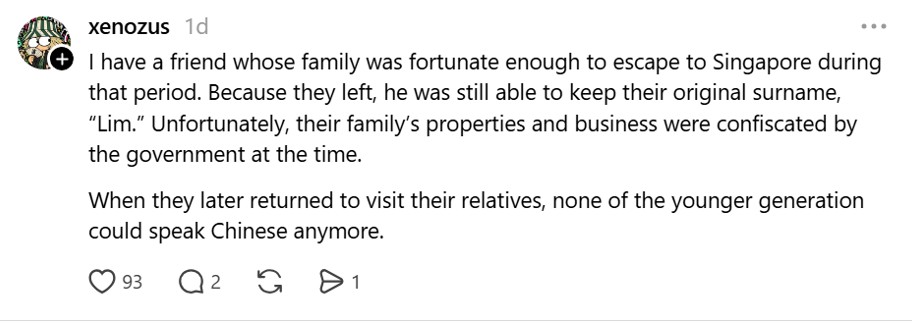
“When they later returned to visit their relatives, none of the younger generation could speak Chinese anymore.”
It was pointed out by a few history buffs that the poster was not well-versed enough in Indonesian affairs to pass such a remark.
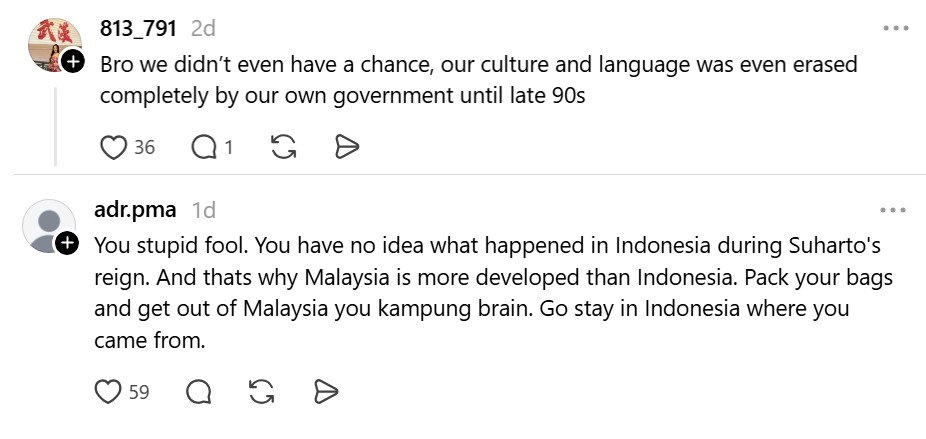
One linguistic expert noted that many Chinese originating in Kelantan could speak the local dialect fluently to the point most had forgotten how to speak Chinese.
This perspective was supported by the poster as proof of language being a useful assimilation tool.
However, one sceptical Malaysian retorted that there was nothing to be proud of as it would not bring any profound benefit, hinting at “no way a “tongkat” (crutches) will be extended to them”.


This latter sentiment was echoed by another observer who cheekily opined that if fluency in the national language would entitle the Chinese to Bumiputera discounts, he was certain that within a decade “all Chinese will speak better Malay than Malays”.

More than a few commenters slammed the poster for his narrow perspective, believing it to be reflective of his small circle of acquaintances and lack of travel.

The poster’s loaded assumption that the Chinese in Malaysia did not understand Malay was also queried. Where was this assumption coming from as most of her Chinese friends have no problems understanding Bahasa Malaysia, asked this bemused commenter.

There were also those who lamented that Indonesian Chinese have forgotten their mother tongue. Was this a desirable trade-off?

Few things to note about this piece of mischief disguised as social commentary.
Firstly, Malaysians should be wary of content that twists historical facts to suit their narrative. It is a convenient tool to use especially with a demographic that knows little about its neighbouring country’s history.
Secondly, cybertroopers such as this use a simple ploy. Throw enough mud and some of it will stick. This post is another obvious attempt at demonising the Chinese community.
Only advice that can be imparted here is to NOT fall for it. – Oct 2, 2026