
THE local automotive industry is expected to remain resilient despite a modest slowdown in vehicle sales this year.
Analysts believe supportive government policies, growing electric vehicle (EV) adoption and continued fuel subsidies will help sustain demand while accelerating the country’s shift towards local EV manufacturing.
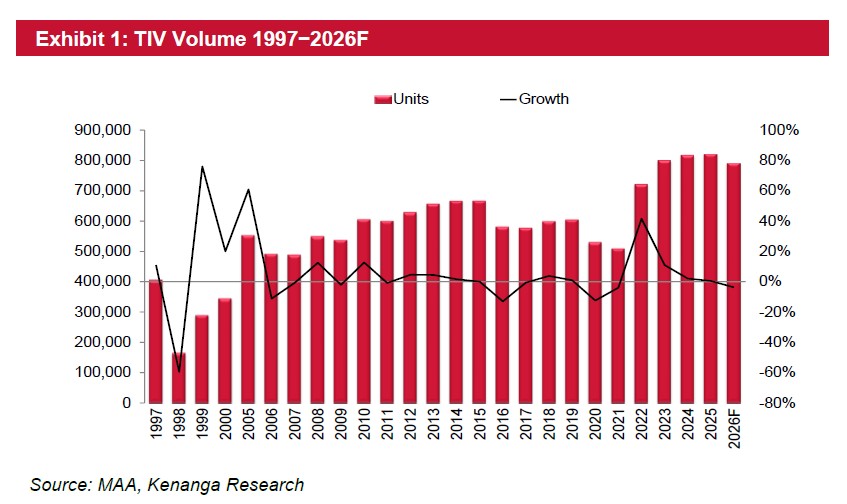
Kenanga expects Malaysia’s total industry volume (TIV) to reach around 790,000 units in 2026, representing a 4% decline from the previous year and broadly in line with the Malaysian Automotive Association’s projection.
Although fuel prices have gradually moderated following renewed peace discussions between the US and Iran, the market remains vulnerable to ongoing geopolitical tensions in the Middle East and disruptions to shipping through the Straits of Hormuz.
Even so, these developments are unlikely to significantly affect domestic vehicle sales.
Demand continues to be supported by Malaysia’s subsidised RON95 petrol, which remains priced at RM1.99 per litre under the BUDI95 programme, compared with the unsubsidised price of RM3.87 per litre at the time of writing.
Despite the monthly subsidised quota being reduced to 200 litres, the government estimates that around 90% of Malaysians consume less than this amount each month.
Kenanga also foresee that new replacement cycles leaning towards electric vehicles (EV) which has significantly increased over the years to 6% of total TIV from below 1% of TIV 5-years ago.
This is looking to reach 10% of TIV by 2027 as automakers ramp up local production, hybrids as well as switching to motorcycles, hinging on the potential removal of subsidies.
For the Malaysian citizen, government announced that starting 1st July 2026, the subsidised diesel price for eligible Malaysians nationwide will drop to a flat RM2.10 per litre.
The mechanism will be the same and shared eligibility with BUDI MADANI program, which is positive to the commercial vehicles (CV) segment, specifically the lifestyle pick-up truck sub-segment which was significantly impacted after targeted diesel subsidies in June 2024 implementation.
Nevertheless, CV market share is still small, accounting for 6% of total TIV (5-years ago at 11%).
By cutting off cheap imports, the government is deliberately creating a protected domestic sandbox to pressure global automakers into building local supply chains.
EV complete build up restrictions on July 1st, 2026 with a pre-tax CIF floor price of RM200k and EV complete knockdown plant restrictions with floor price of RM100k as well as 80% production volume must be exported which were created to foster phased transition from an import-reliant EV marketplace to a localized EV manufacturing ecosystem.
Beneficiaries of ready EV local production would be Perodua from its own smart mobility plant, Proton and Zeeker under Proton’s Tanjung Malim Plant, TQ Wuling Bingo under TCHONG’s Segambut plant and Xpeng, GWM, BAIC & SAIC brands’ under EPMB’s Melaka plant.—July 17, 2026
Main image: riskandinsurance.com