


MALAYSIA’S automotive market softened in August 2026, but the country’s electric vehicle sector reached a record monthly high, driven overwhelmingly by the Proton e.MAS 5.
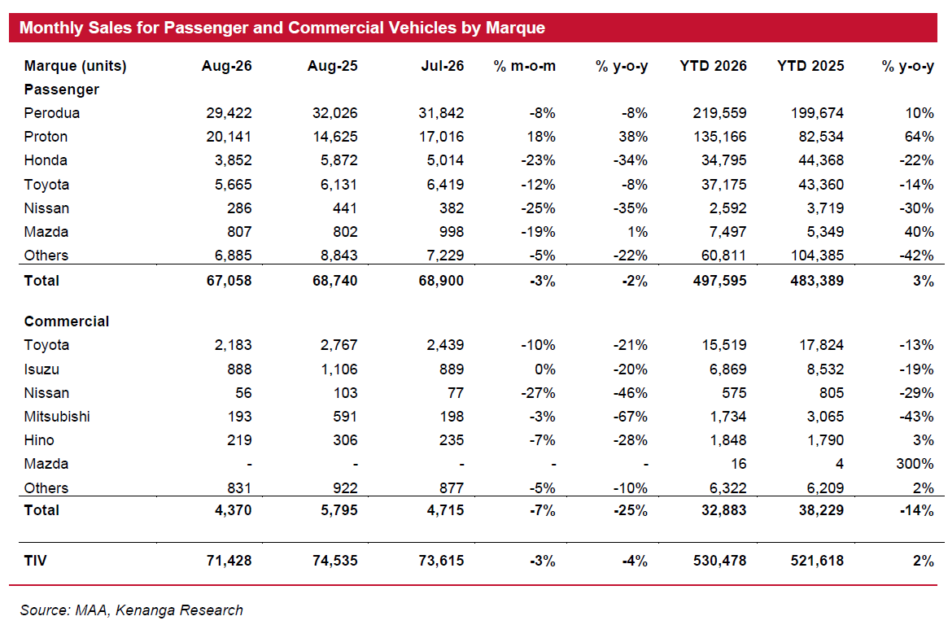
Total industry volume (TIV) declined 3% month-on-month (MoM) and 4% year-on-year (YoY).
The decline came amid a shorter working month, with two public holidays falling in August – Prophet Muhammad’s Birthday on Aug 25 and Merdeka Day on Aug 31.
However, the weaker overall market did little to dampen Malaysia’s electric vehicle (EV) segment, which posted its strongest monthly performance to date.
A total of 8,833 battery-electric vehicles were registered during the month, although one model accounted for more than half of that figure.
The Proton e.MAS 5 contributed 4,770 registrations, giving it a 54% share of all EV registrations in August.
According to Kenanga Research, this marked the first time a single EV model captured more than half of monthly registrations since the market surpassed the 1,000-unit threshold.
But the headline EV record comes with an important caveat.
Excluding the e.MAS 5, registrations for the rest of the EV market actually fell from 4,535 units in July to 4,063 units in August, representing a 10% decline.
This suggests that August’s record EV performance was largely driven by the overwhelming contribution of a single model, rather than broad-based growth across the segment.
The weaker performance among other EV brands is believed to have been linked partly to dwindling completely built-up (CBU) inventory, particularly for BYD.
For the month of September 2026, we expect sales to sustain around the current level on continuous sales promotion with specific boost from Perodua on price reduction across its second-generation Axia up to RM4,700 and sustained level of commercial sales with the introduction of BUDI Diesel in July 2026, replacing the cash rebate with a direct subsidy at the pump via MyKad verification across Malaysia.
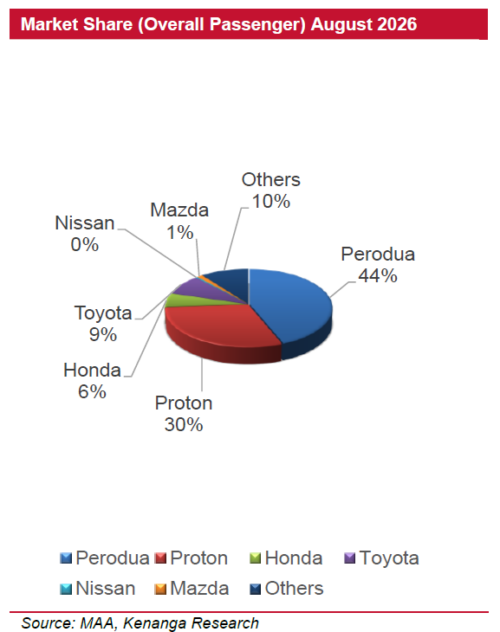
Year-to-date TIV of 530k units (+2%) is well within our expectation. National marques (66% TIV share) stood their ground.
This was seen in Perodua (41% TIV) and Proton (25% TIV), backed by strong sustained demand in the affordable segment, and attractive new launches.
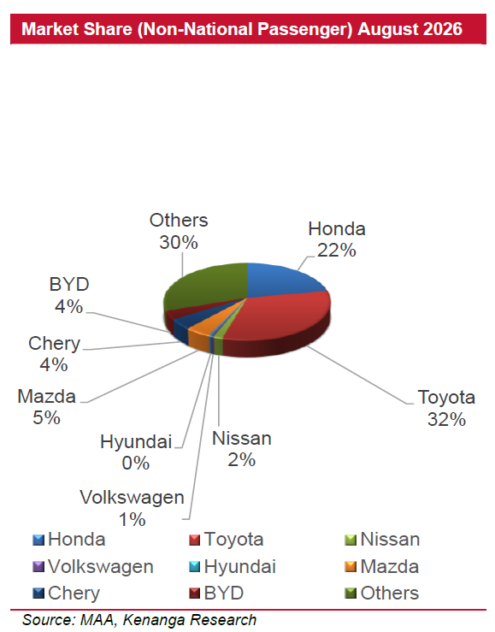
In the non-national marques segment, for the month of August 2026, Toyota took 1st place at 32% of TIV market share, leaving Honda behind at 2nd place at 22% as Toyota Hilux was boosted by the introduction of BUDI Diesel, and its hybrid sales continued to dominate the market.
Mazda placed third at 5% due to higher complete built-up (CBU) delivery of Mazda 3, overtaking Chery at fourth place commanding 4%, and BYD at 5th place with 4% which we believe was due to dilution of its market share in the non-nationals segment due to new launches and attractive discounting/rebates promotion.
The larger issue with BYD is that its CBU inventory is almost depleted while awaiting complete knockdown (CKD) localisation at its third-party manufacturing plant, which we believe will be at Inokom Corporation Sdn Bhd, under SIME and BAUTO.
“We expect gradual transition to battery electric vehicles which currently benefit from tax exemption until 2027 for locally assembled CKDs,” said Kenanga.
Looking further, the research house also have a balanced view of EV adoption eventually picking up and demand for gasoline vehicles eventually peaking, but not within the next five years due to infrastructure challenges.
The domestic market is still protected by the subsidised fuel pricing mechanism which offers lesser incentives for middle-and lower income-groups to switch from ICEs to EVs.—Sept 21, 2026
Main image: Anebon.Metal