

FOR MARCH 2026, Kenanga anticipates softer sales, largely attributed to a shorter working period during Hari Raya Aidilfitri, when plants shut for a week for scheduled maintenance and additional public holidays.
Among the standout developments, Honda appears to be defying the broader slowdown with appealing discount and rebate campaigns.
Meanwhile, Mazda’s performance is being affected by tighter delivery timelines, as global supply limitations continue to constrain shipments of its key volume model, the Mazda 3 1.5L CBU import.
National marques (76% TIV) stood their ground, wrestling share from the non-national marques.
This was seen in Perodua (46% TIV) and Proton (30% TIV), backed by strong sustained demand in the affordable segment and attractive new launches. 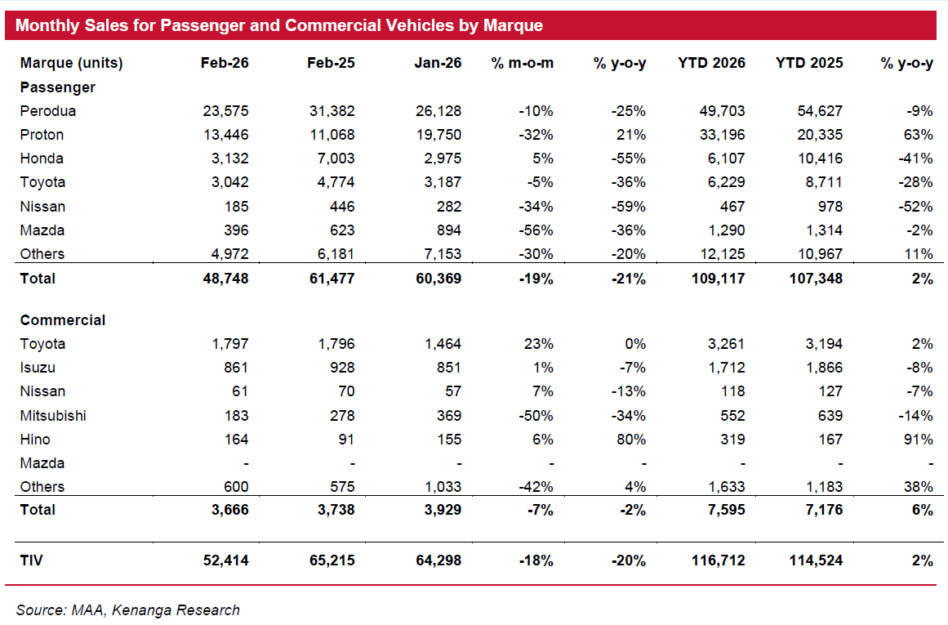
In the non-national marques segment, for the month of February 2026, Honda & Toyota were in a tight battle (27% and 26% of TIV share, respectively).
Chery took 3rd place (8% TIV), while BYD slipped to 4th place (4% of non-national TIV share) which Kenanga believes was due to dilution of the electric vehicle (EV) market share especially with the strong sales of Proton e.Mas 5 in the national marques segment.
Kenanga expects gradual transition to battery electric vehicle (BEV)s which currently enjoys tax exemption up until 2027 for locally-assembled complete knockdowns.
“Looking further, we also have a balanced view of EV adoption eventually picking up and gasoline vehicles demand will eventually peak, but we do not think that will happen in the next five years due to infrastructure challenges,” said Kenanga.
This new petrol subsidy mechanism, in their view, could make the transition even slower than earlier expected as the middle- and lower- income groups now have less incentive to switch from ICE to EV for the time being.
Recall that, the new registration for BEVs leapt from 274 units in 2021 to over 3,400 units in 2022, 13,301 units in 2023, 21,789 units in 2024 and 44,800 units in 2025, or 5.5% of TIV.
Malaysia aims for electric vehicles to represent 20% of new vehicle sales by 2030, with the longer-term vision of 80% by 2050 (including hybrids vehicles).
Government is currently focused on building out the EV ecosystem, including establishing 10,000 public charging points with current number of proposed charging stations currently at 4,477 (5,149 built-to-date) amid the provision of tax incentives to stimulate adoption and local production.
There is no updated timeline target yet from the earlier one by 2025, despite the current build-to-date lagging with just tad above 50% of the target. —Mar 30, 2026
Main image: Visionx