
APEX Securities remains Overweight on Malaysia’s plantation sector, citing potentially tighter palm oil supply, resilient demand and elevated crude palm oil (CPO) prices.
It maintains its CPO price forecasts at RM4,500 per tonne for 2026 and RM4,700 per tonne for 2027, with 2027 prices expected to average RM4,800 in the first half and RM4,600 in the second half.
The research house expects El Niño-like weather conditions to weigh on fresh fruit bunch (FFB) yields from the first half of 2027, with its forecasts already assuming a 7% decline in monthly FFB yields in the first half of financial year 2027.
Prolonged dryness could further tighten supply and provide upside risk to CPO prices.
Biodiesel remains a structural demand driver, particularly as Indonesia implemented its B50 mandate in 2026 and evaluates B60 for 2027.
However, Apex believes the immediate impact of B60 could be limited by existing biodiesel production capacity and has therefore excluded additional B60-related demand from its CPO price assumptions.
For Budget 2027, Apex expects the Government to focus on independent smallholders, particularly through higher replanting allocations, larger grants and improved financing under the TSPKS programme.
Further support for MSPO certification could also improve market access and strengthen Malaysia’s sustainability and traceability credentials, although the direct earnings benefit for large listed planters is likely to be limited.
 A potential review of the windfall profit levy could provide some relief as CPO prices remain well above current levy thresholds, while a possible minimum wage increase to RM1,700–RM2,000 could raise plantation costs.
Apex estimates a RM2,000 minimum wage could reduce core net profit by 10.8% for Hap Seng Plantations and 6.8% for Johor Plantations.
Apex favours upstream planters because higher CPO prices can translate disproportionately into earnings due to their semi-fixed cost structure.
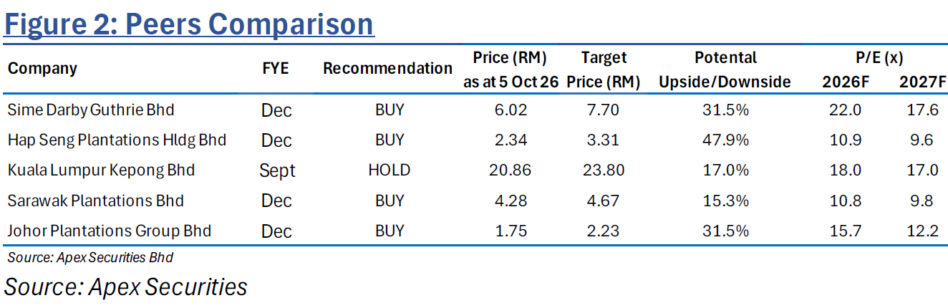
Its top picks are Hap Seng Plantations and Johor Plantations Group.
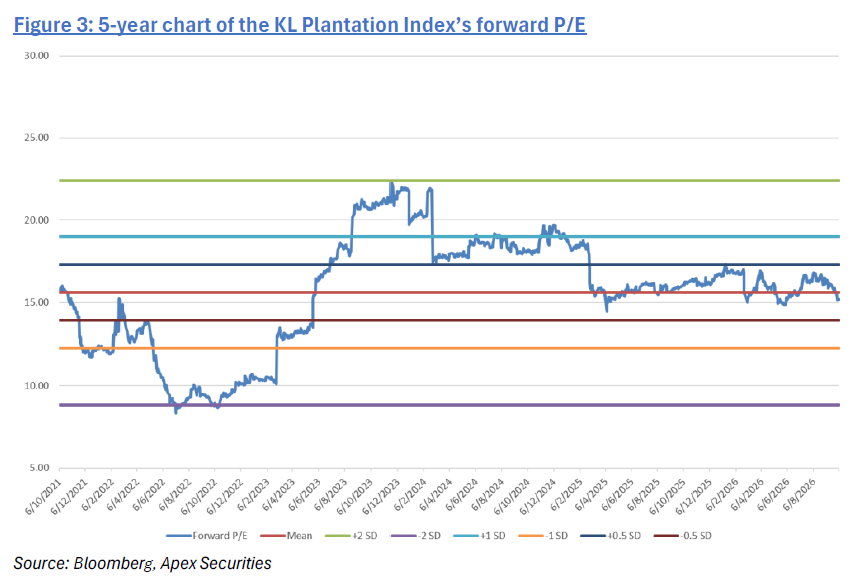
Sector valuations are viewed as reasonable rather than stretched, with the KL Plantation Index trading at about 15.2 times forward earnings versus its five-year mean of 15.6 times.
Key risks listed by Apex include higher estate costs, weaker El Niño effects, higher inventories, softer export demand, delayed B60 implementation and stronger global vegetable oil supply.—Oct 6, 2026
Main image: Bloomberg