
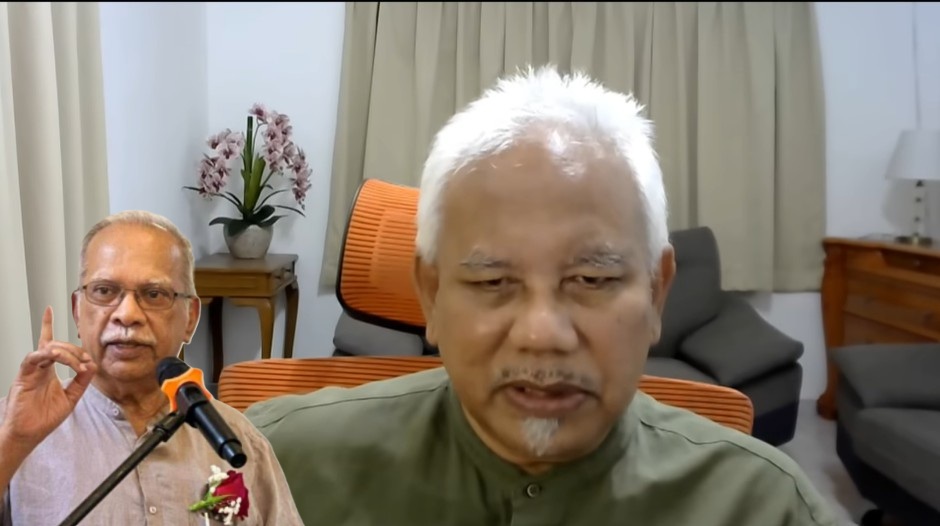
ACADEMIC and political commentator Prof Mohd Tajuddin Rasdi has the knack of raising controversial issues and most of the time getting away with it.
His theory of Malay attitudes towards corruption on the Free Malaysia Today (FMT) news portal seems to be something bizarre and does not even qualify to be termed as a theory.
Yet he thinks that his theory as to why Malays don’t care about corruption merits scholarly attention in the form of a doctoral dissertation.
Tajuddin gives six reasons why Malays accept corrupt leaders without much problem.
They are that (i) Malays don’t pay taxes; (ii) they depend on the government for their income; (iii) lack of awareness; (iv) the sorry state of religious education; (v) party benefits; and not least, (vi) the DAP bogeyman factor.
‘Awareness level is rising’
I think these reasons cited by Tajuddin are rather bizarre without any material basis. It is blatant untruth to claim that Malays pay little taxes, hence this is the reason why they are unaffected by the siphoning of public funds.
Rich Malay companies pay taxes but tax evasion is another thing.
Non-Malays might pay more taxes not because they are non-Malays but because their revenue base is broader and deeper.
Malays are fond of disgraced former premier Datuk Seri Najib Razak not because they tolerate his corruption but because he was perceived to be generous with handing out financial assistances of sorts during his tenure.

The majority of the Malays might be employed in the public sector; however, this has no bearing on their propensity to tolerate corruption.
It is absurd to say that Malays lack awareness and this is one of the reasons why they tolerate corruption.
Awareness is a relative phenomenon that is not based on ethnicity. There are Malays who are fully aware of the evils of corruption and those who might not be aware.
The same thing could be said about the Chinese, Indians and others. Awareness has nothing to do with ethnicity.
Religious education might not over-emphasise the concept of corruption but no religion condones the evil of corruption.
Tajuddin seems rather over-simplistic in linking corruption to religious education. Not all Malays benefit from the funds allocated by Malay parties.
Injustice to incorruptible Malays
Again, this simplistic and generalised impression has no bearing on the Malays’ acceptance of corruption.
And finally, I really wonder what the dislike of the Malays towards DAP has to do with their support of corrupt Malay leaders.
They might dislike DAP for being a Chinese party, its history of fighting for the rights of non-Malays and others.
Just because they dislike DAP doesn’t mean that they support corruption.
I am truly amazed that an academic like Tajuddin who has written exceptional commentaries in the past could divert his attention to the subject matter of why Malays tolerate corruption.
If Malays have no issue with corruption, how would he explain the plethora of laws that exist to stem the scourge of corruption in the country?
By the way, those heading the MACC (Malaysian Anti-Corruption Commission) and the prosecution are mostly Malays.
Well, if Malays have a great deal of tolerance for corruption, then how do we explain the moves against corruption in the country?
Tajuddin can criticise the Malays but certainly not to the extent of claiming that Malays tolerate corruption.
This is not fair to the Malays, especially those who fought against corruption. – Oct 7, 2026
Former DAP stalwart and Penang deputy chief minister II Prof Ramasamy Palanisamy is chairman of the United Rights of Malaysian Party (Urimai) interim council.
The views expressed are solely of the author and do not necessarily reflect those of Focus Malaysia.