

I SPENT several days visiting electoral constituencies in Negeri Sembilan (N9) last week.
The central question is which coalition will form the next state government after votes are tabulated from its 36 constituencies.
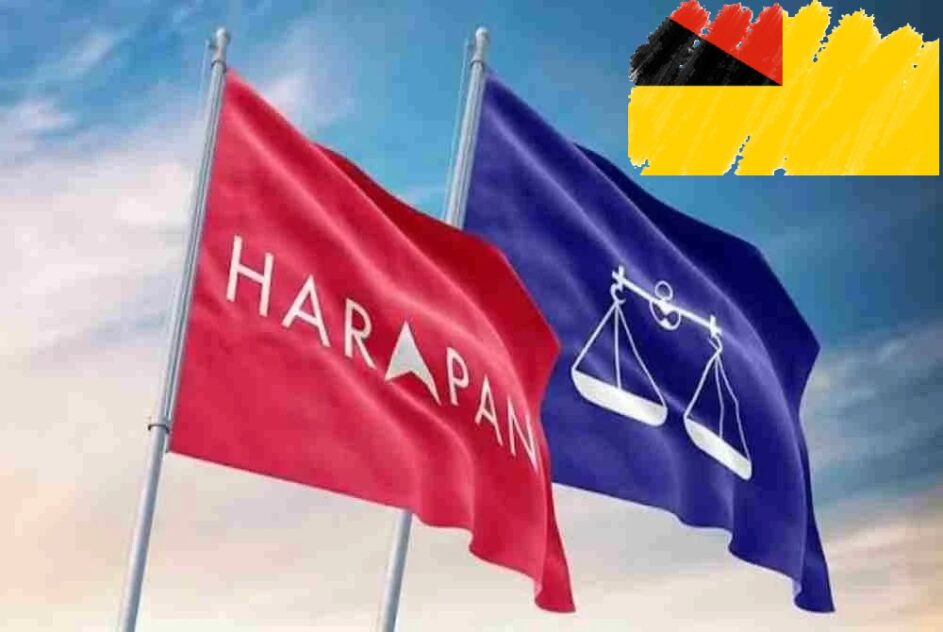
The contest is essentially a two-horse race between the Barisan Nasional (BN)-PAS pact which rides on the ummah unity motto and the Pakatan Haraoan (PH) coalition.
BN’s victory in the recent Johor state election has strengthened its prospects of winning more seats in Negeri Sembilan.
The lack of support for PAS/Perikatan Nasional (PN) in Johor and N9 appears to have influenced PAS to back BN, largely on the grounds of race and religion.
This support is not born out of political altruism but electoral necessity.
Compared to PH, BN is perceived as less tainted in N9. PKR and Amanah have been unable to deliver sufficient Malay support to PH while the coalition’s prospects among non-Malay voters have also weakened considerably.
Discontentment with DAP
If PH is to retain power, it will have to rely heavily on Chinese and Indian voters. Unfortunately, three years of PH administration in N9 have failed to convince many non-Malays that the coalition has adequately protected their interests.
The DAP’s role in the federal government is a major reason why many non-Malay voters, particularly the Chinese, have become disillusioned with the party’s leadership.
There are numerous accounts of DAP national leaders receiving hostile receptions during constituency visits with some reportedly being heckled and booed.
This stands in sharp contrast to the enthusiastic welcome they received during the last state election campaign.
Among Chinese voters, dissatisfaction has been fuelled by the DAP leadership’s inability to resolve the pig farming issue and its lacklustre performance on the recognition of UEC graduates for admission into public universities.
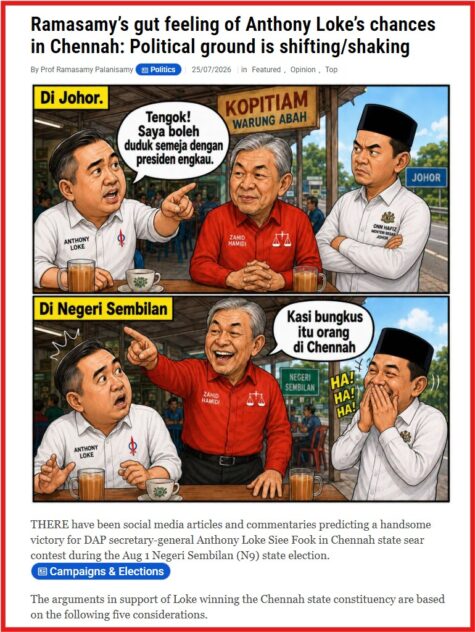
Chinese-owned transport companies have also been adversely affected by the strict enforcement carried out by the Road Transport Department (RTD) under purview of Transport Minister who is none other than DAP’s very own secretary-general Anthony Loke Siew Fook.
Indian lorry drivers are equally upset with the government’s strict enforcement against even minor regulatory infringements. The seizure of vehicles has left many without salaries and allowances.
Indians who constitute more than 20% of the electorate in many constituencies appear increasingly frustrated with the PH government and DAP in particular.
Lightening to strike twice
While many Chinese voters tend to be angry with DAP, their Indian counterparts are furious with Prime Minister Datuk Seri Anwar Ibrahim.
They have not forgiven PMX over the conversion of a Hindu youth to Islam, the demolition of what were deemed “illegal” Hindu temples, the forced relocation of a 130-year-old Hindu temple in Kuala Lumpur – which he described as a victory for Islam – and what they perceive as his failure to address the financial needs of the Indian community.
UMNO may have been the driving force behind the decision to call the state election before the expiry of the assembly’s full term.
Although BN remains part of the federal unity government, it ignored PMX’s reported advice against holding an early election.
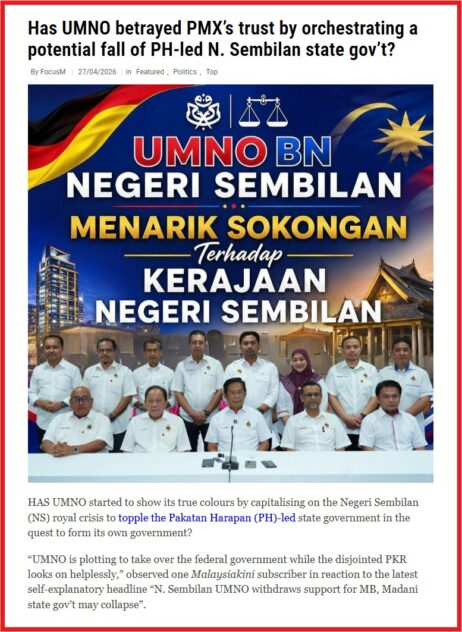
BN may be a partner in the federal government but much of the public’s frustration appears to be directed at PH.
Given the shift in Malay support which has been further reinforced by PN’s backing of BN, it is likely that a substantial share of Malay votes will flow to BN.
PAS and PN may have limited influence in directly persuading votersbut their endorsement strengthens BN’s position.
Bersatu is the only opposition party contesting independently in the N9 state polls by fielding candidates in 24 seats.
PAS has effectively abandoned its oppositional role within PN in favour of supporting BN.
As I have argued before, what happened to PH in Johor may well be repeated in N9. While the outcome may not mirror Sabah, PH appears headed for a serious electoral setback. – July 28, 2026
Former DAP stalwart and Penang deputy chief minister II Prof Ramasamy Palanisamy is chairman of the United Rights of Malaysian Party (Urimai) interim council.
The views expressed are solely of the author and do not necessarily reflect those of Focus Malaysia.