

BESTINET Sdn Bhd, the provider of the Foreign Workers Centralised Management System (FWCMS) for holistic and digital foreign worker management, has responded to various questions and allegations frequently directed at the company.
The current criticism does not reflect good-faith policy discourse as certain public figures have used these national infrastructure systems as instruments of political positioning by making false allegations based on selective and decontextualised data, according to the company.
“Their opposition is not principled governance advocacy. It is the defence of a financial ecosystem that has profited for decades from the exploitation of vulnerable migrant workers,” Bestinet which was founded by Bangladesh-born Datuk Seri Aminul Islam Abdul Nor highligted in a statement issued through legal firm Lui & Bhullar.

“Bestinet will take all necessary legal action against false, misleading or defamatory statements,” it further warned.
Before and after
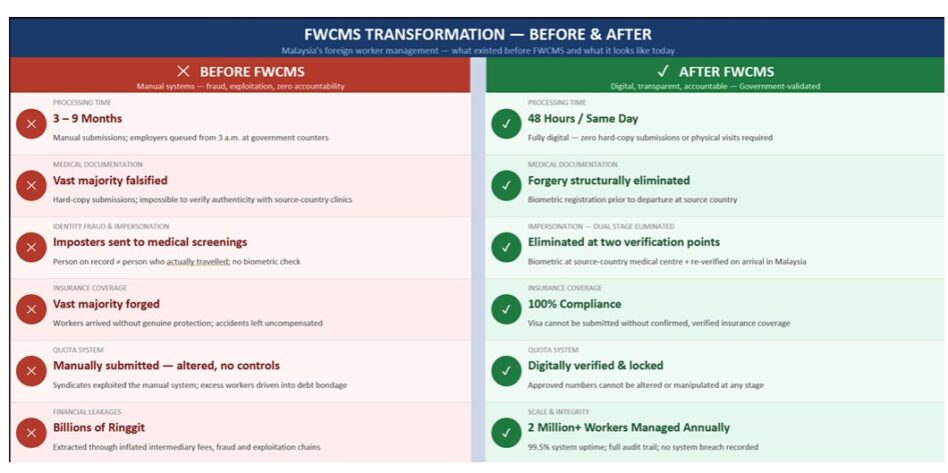
Delving further on FWCMS migrant worker management system, Bestinet claimed that the system “has eliminated billions in annual leakage previously flowing through informal intermediaries”.
“Before FWCMS, Malaysia’s foreign worker management ecosystem was manual, fragmented and vulnerable to abuse with no digital records, no audit trail and no accountability,” recounted Bestinet.
Ministries operated in silos with no integration. Employers queued as early as 3am at government counters, creating repeated opportunities for illicit and unrecorded payments.
“In the vast majority of cases, medical reports and insurance documents were falsified. In many cases, workers sent imposters to medical screenings.
Quota applications were manually manipulated through collusion between employers, brokers and intermediaries, generating artificial demand to extract money from vulnerable workers who often arrived in debt bondage.
Derived from industry assessments and historical observations, the financial leakages ran into the billions of ringgit.
However, since Bestinet introduced FWCMS and transformed the ecosystem, it undertook a privately funded national initiative to build a world-class digital solution at zero cost to the government or taxpayer.
“Today, the FWCMS is a 15-module cross-border governance platform – the first of its kind globally – integrating 15 labour-sending countries, 232 accredited medical centres and every relevant Malaysian government agency into one unified digital ecosystem,” claimed Bestinet.
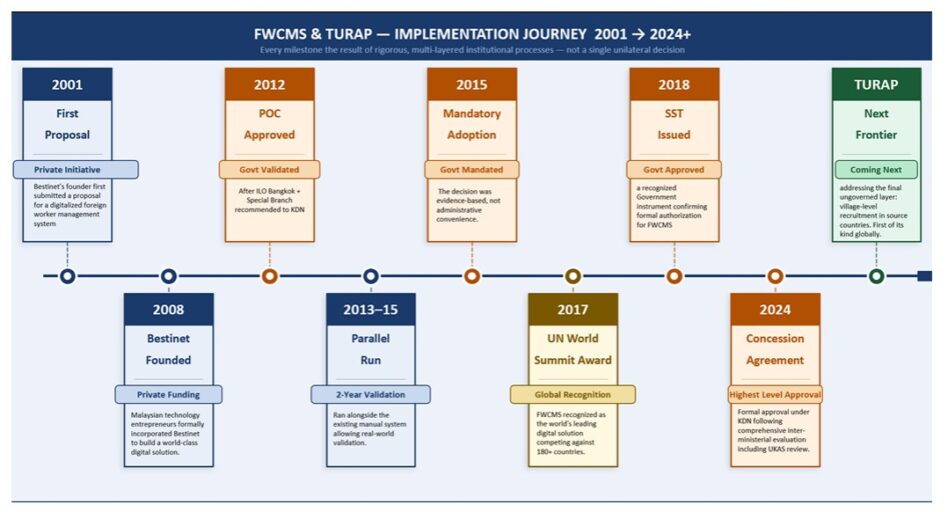
“It received formal government approval through the SST in 2018 and concession agreement in 2024 following a comprehensive inter-ministerial evaluation including review by UKAS (UK Accreditation Service).”
“TURAP meant to complement, not replace”
Bestinet further denied assertions that the fee structure represents an increase as “factually incorrect”.
“In fact, after a negotiation with UKAS, the revised fee absorbed the previous separate services like PLKS (temporary employment pass), ISC (immigration security clearance)and medical screening, overall representing a significant reduction,” revealed the company.
“Also to be noted is that Bestinet provided its services without any fee collections from 2012 to 2018.”
With regard to its proposed Universal Recruitment Advanced Platform (TURAP) as the next frontier in worker protection, Bestinet said “no government or employer body anywhere in the world today possesses effective mechanisms to oversee, verify or govern this layer whereby the most acute exploitation of migrant workers occurs”.
“TURAP is the first platform of its kind in the world, developed drawing on nearly 40 years of cumulative industry experience,” asserted Bestinet.
“It’s designed to complement – not replace – FWCMS, MyIMMS, NIISe and all other government systems – operating at a distinct upstream layer to eliminate recruitment exploitation at its source.”
On concerns related to national security and sovereignty, Bestinet has contractually committed to transfer full ownership of FWCMS to the Malaysian government upon contract completion.
It thus concluded:
Every government decision on FWCMS – from the 2012 POC (a proof of concept) through mandatory adoption in 2015, to the 2024 formal contract – resulted from rigorous, multi-layered institutional processes including inter-ministerial consultations, security assessments, international advisory input and over a decade of evidence-based performance review.
Any characterisation of these decisions as irregular, improper or influenced by extraneous factors undermines the institutional integrity of Malaysia’s executive decision-making. – April 24, 2026