
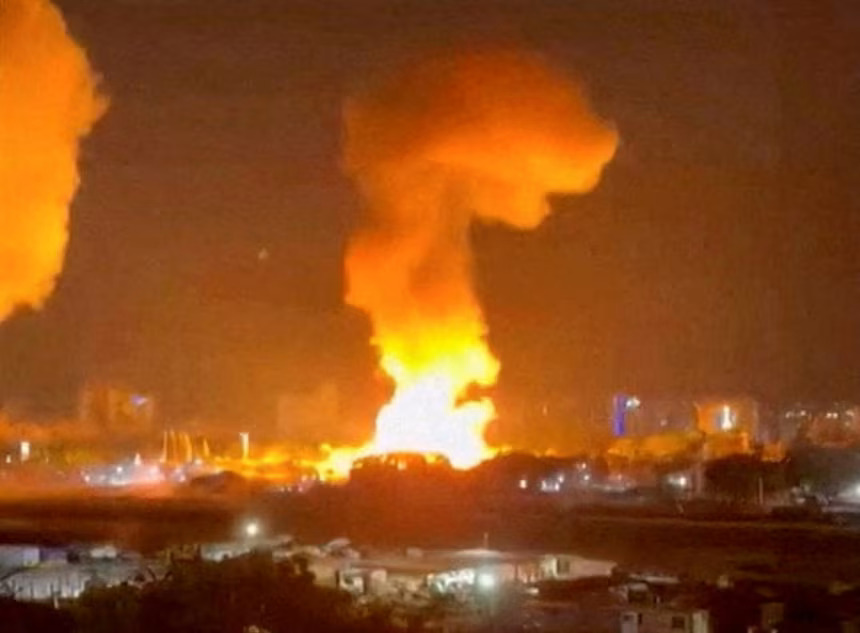
A HOST of countries has voiced concern that rules of international law had not been followed.
Falling in the side on a harsher tone, China said it is deeply shocked and strongly condemns the use of force against a sovereign nation and its president, while Russia termed it as an act of armed aggression.
Beyond strong rhetoric against the strike and the seizing of the Venezuelan President, our base case is that we foresee China and Russia will exercise restraint and not materially interfere.
For the former, US president Donald Trump in saying that US wants to “run” Venezuela will keep oil flowing to China.
Secondly, we believe China has its focus trained on its own economy especially post the imposition of US tariffs.
Meanwhile, for Russia, we believe despite its relations with Venezuela, Russia does not want to risk its working relations with Trump’s administration.
The focus right now shifts to how the US can manage a power transition in Venezuela. With an interim leader at the helm of Venezuela at time of writing, we don’t expect highly choppy markets.
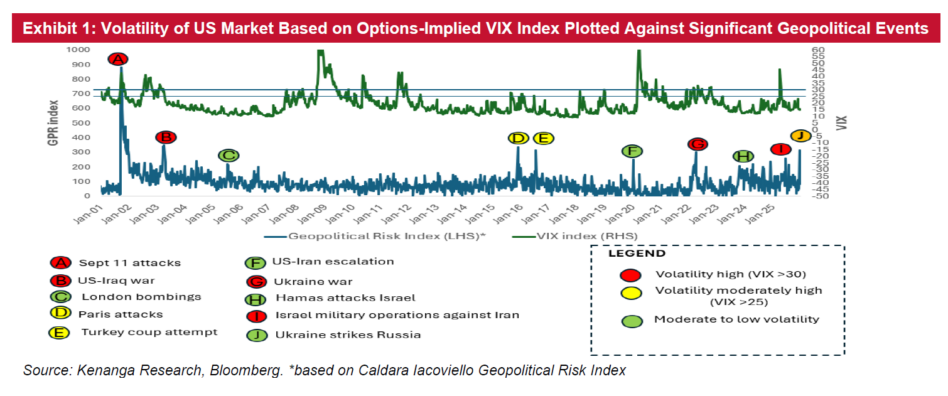
This is from studying the past behaviour of the VIX index, which represents US equities votality, in the face of geopolitical risk.
For this, we analyse volatility from the lens of the Geopolitical Risk Index compiled by Fed economists which uses results on text-search from 10 newspapers relating to adverse geopolitical events.
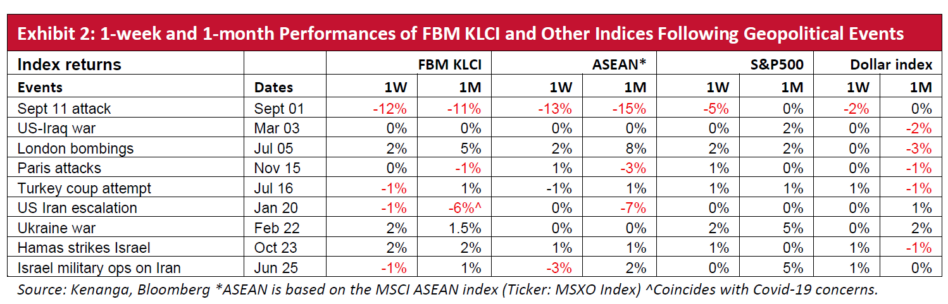
We find that that not all geopolitical incidents immediately translate to high volatility, but only in some cases (red circles), where war was present or a conflict has the potential for contagion.
At this juncture, as we don’t see such conditions present in Venezuela’s case, we expect volatility to stay at moderate, providing some possibilities to take tactical positions.
Overall we prefer to buy quality stocks on dips. At time of writing, it is not all clear how commodities markets will respond once the markets reopen post weekend.
Kenanga’s view is for supply tightness to remain from Venezuela – analyst Lim Sin Kiat elaborates in his Oil and Gas sector update today “Waiting for the Pivot”.
A supply tightness from Venezuela may affect China more, as 5-8% of its total imports stem from Venezuela.
Since 2017, US has already imposed sanctions on Venezuela’s ability to export to the US whose dependence on sour crude from Venezuela at 1-2% of US own total refinery throughpout is modest.
US President Donald Trump has also claimed that US oil and gas giants will invest in Venezuela, which has the largest oil reserves in the world, to rebuild its sub-optimal oil production infrastructure.
For the crude market, we believe that the impact would just be sentiment-driven.
The net effect to supply would be minimal at this juncture; supply disruption could be covered by a potential OPEC production ramp up underpinning our modest positive-impact view. —Jan 5, 2026
Main image: Reuters