
AS Malaysia’s Sepang International Circuit prepares to host the Formula 1 Gulf Air Bahrain Grand Prix from October 2 to 4, most attention will be on the speed, spectacle and precision unfolding on the track.
Behind the scenes, Malaysia’s experienced agencies and event stakeholders will again draw on well-established coordination, trusted information-sharing and operational continuity practices to keep essential services connected throughout the event.
Major sporting events bring together officials, responders, transport operators, utilities, broadcasters and organisers across a highly connected environment.
For a few intense days, it becomes a small city operating at extraordinary speed, under international scrutiny, where clarity, coordination and confidence matter at every step.
That is why modern event management is increasingly a national resilience challenge.
When coordination matters most
Malaysia understands this challenge, having hosted Formula 1 at Sepang for nearly two decades, the recent SUKMA (Malaysia Games) and now preparations for the 2027 SEA Games.
The country has deep experience bringing people, organisations and infrastructure together for world-class events, including the 2025 ASEAN Summit, which involved high-security coordination across hundreds of events and thousands of personnel.
What keeps changing is the risk environment around these events. The more connected they become, the more dependent they are on systems that must keep working when conditions are at their most difficult.
The risk ‘ripple effect’
Consider a severe thunderstorm, vehicle incident, infrastructure outage or security concern emerging during a major event.
What begins as one operational issue can quickly require coordinated action across police, emergency services, transport, health, utilities and communications providers.
Resilience planning is about ensuring agencies can continue to share verified information, make decisions and act from a common view of the situation, even when conditions are complex or fast-moving.
That is the reality of modern emergency management. Key decisions often happen between agencies, operators and response teams before they are visible to the public, supported by workflows that reduce manual handoffs and help teams act at the speed of the incident.
The question is simple: can the right people receive the right information, understand what is happening and coordinate a response within minutes, even when routine channels are under pressure?
Modernising incident response
For decades, emergency communications focused on getting information to the right people quickly through phone calls, email, radio or public announcements.
Those tools remain a critical part of standard operating procedures, but emergencies also demand trusted communication between the agencies and operators coordinating decisions under pressure.
Police may need to share incident details with transport authorities, medical teams may need to confirm access routes, and cybersecurity teams may need to verify whether an outage is technical, malicious or accidental.
Personnel on the ground must also feed information back to the command centre so leaders can build a common operating picture: what happened, which agencies are involved, what has been actioned and what needs to happen next.
Modern critical-event management is evolving towards shared situational awareness that connects verified information sharing, personnel accountability, field reporting, escalation paths and response workflows. This requires resilient, out-of-band communications that can operate when routine channels are unavailable.
The goal is not to replace existing agency command structures or technology. It is to augment the systems already in place, strengthening the ability to coordinate clearly when time, trust and continuity matter most.
Cyber resilience is event resilience
Cybersecurity is now integral to event resilience and public safety.
Paris 2024 showed the scale of the challenge. France’s national cybersecurity agency, ANSSI, identified nearly 500 entities in the Games ecosystem and recorded 548 cybersecurity events between May 8 and September 8, including 83 confirmed incidents.
More than 140 cybersecurity events were reported during the Olympic and Paralympic period, but none affected the ceremonies or the running of the competitions.
Similar risks have been observed around recent global football tournaments, as reported by the World Economic Forum.
Today’s sporting events depend on digital ecosystems spanning government, telecommunications, transport, venues, ticketing and suppliers. When disrupted, consequences can become operationally significant quickly.
Strong resilience planning ensures security teams, emergency services and organisers can continue to communicate, maintain operational clarity and preserve situational awareness even if routine systems are disrupted.
The focus is continuity: keeping the right agencies connected, informed and able to coordinate when conditions change.
Beyond the race
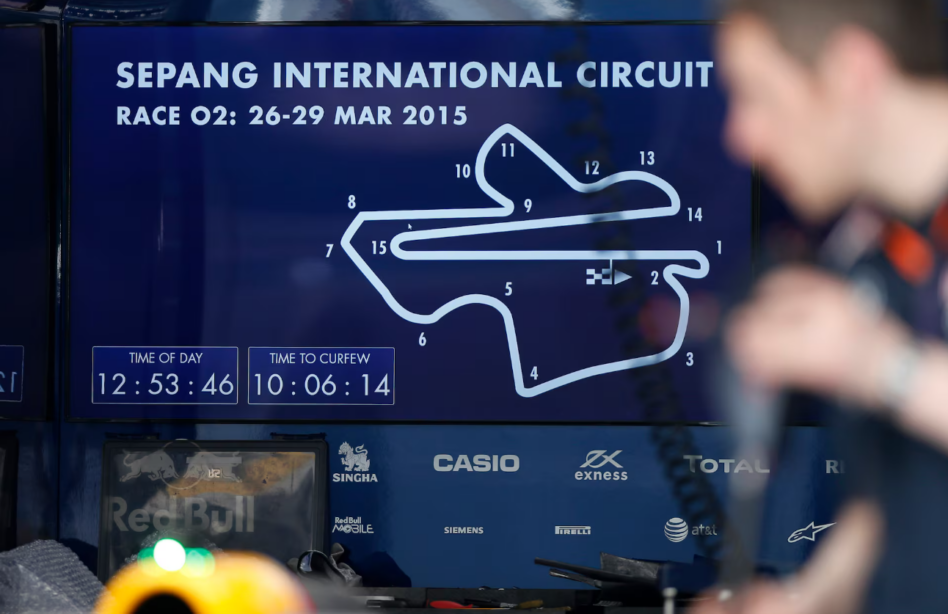
Formula 1 provides a timely opportunity to demonstrate Malaysia’s major-event resilience.
The 2025 ASEAN Summit and SUKMA were a strong foundation for multi-agency coordination. The 2027 SEA Games will raise the bar again as a dispersed event across Kuala Lumpur, Sarawak, Penang and Johor, with added complexity across venues, transport, security and emergency services.
The scale changes. The fundamental questions do not.
Which agencies need to act? Who has verified information? Can decision-makers share a common picture? How do teams maintain continuity when conditions change?
Planning, rehearsal, trusted coordination and reliable technology platforms can answer those questions long before race day.
Ready to race
Malaysia’s experience hosting major international events provides an opportunity to strengthen the systems that support them.
That opportunity is strengthened when agencies, organisers, venue operators, emergency services and critical infrastructure providers plan as one system, linking emergency management, cybersecurity, transport, communications and public safety before disruption occurs.
When the flag drops and the lights go green at Sepang, drivers react in milliseconds. Malaysia’s event ecosystem is built around the same principle: speed, precision and coordination when it matters most. ‒ Oct 1, 2026
Jonathan Jackson is the APAC Field CISO for BlackBerry Secure Communications.
The views expressed are solely of the author and do not necessarily reflect those of Focus Malaysia.
Main image: Facebook/Mercedes-AMG Petronas F1 Team