

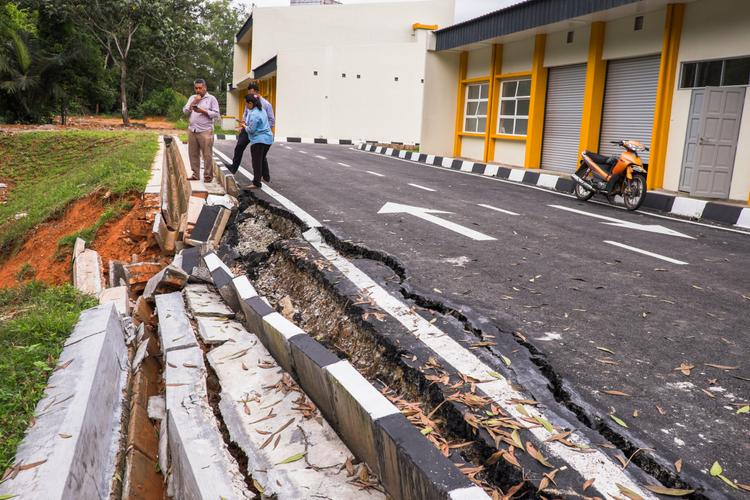
SINCE 2019, the majority of new government buildings in Malaysia have incorporated earthquake-resistant designs. This shift came after the Malaysian Annex Standard for seismic design, first introduced in 2017 and formally adopted in 2019, was put into force.
The Annex serves as a local adaptation of international standards, tailored for Malaysian conditions, particularly in relation to seismic resilience.
According to Dr Nur Hajarul Falahi Abdul Halim, an Earthquake Engineering specialist from Universiti Teknologi Malaysia’s Faculty of Built Environment and Surveying, the guidelines are applied mainly to government projects and developments in higher-risk regions such as Kuala Lumpur and Sabah.
He explained that Malaysia’s older buildings were generally not built to withstand seismic activity. However, the 2015 earthquake in Ranau, Sabah, highlighted the risks and prompted authorities to strengthen building requirements.
“Malaysia’s approach to earthquake-resistant design focuses heavily on materials and structural reinforcement, for example, using higher-grade concrete and customised steel reinforcement to match the level of risk,” he said in an interview.
The framework itself is aligned with Europe’s Eurocode standards, which prioritise flexibility in structural design, enabling buildings to endure small to moderate tremors typical of Malaysia’s seismic profile.
While technologies such as seismic isolators are in use locally, particularly for critical infrastructure like bridges and specific buildings, their deployment remains relatively limited nationwide.
Dr Azlan Adnan, a Fellow of the Academy of Sciences Malaysia and Deputy President of the Malaysian Structural Steel Association (MSSA), noted that Malaysia could draw lessons from earthquake-prone regions including Japan, California, and Türkiye.
“Best practices include employing high-strength reinforced concrete, precision steel joints, adaptable designs, and structural health monitoring systems for large-scale developments,” he said.
He added that Malaysia is not trailing behind in terms of technology. In fact, the nation has developed its own natural rubber-based ‘Base Isolator,’ already adopted in countries such as Indonesia, Japan, and the United States.
Research universities including UTM, Universiti Sains Malaysia (USM), and Universiti Kebangsaan Malaysia (UKM) are also actively pursuing studies and simulations in seismic design.
Dr Azlan emphasised that Malaysia’s more selective application of earthquake-resistant measures is not a shortcoming but rather a reflection of the country’s lower seismic risk compared with places like Japan, where earthquakes occur daily. —Aug 26, 2025
Main image: 123RF