
KENANGA Research has maintained its Overweight call on the nation’s oil and gas sector, expecting upstream capital expenditure (capex) to recover in 2027 and potentially peak in 2028 as crude oil prices remain supportive and Petronas seeks to maintain production.
The research house raised its FY26 and FY27 Brent crude forecasts to US$91 and US$85 per barrel respectively, citing prolonged US-Iran tensions and uncertainty in the Middle East.
While a full resolution is unlikely in the near term, Kenanga expects a partial US-Iran deal in 2027, with a US$5 per barrel geopolitical premium remaining in its forecast.
Despite elevated oil prices, Kenanga does not expect a structural, multi-year crude oil upcycle because OPEC and the UAE retain spare production capacity.
Its base case assumes the Strait of Hormuz will gradually reopen in 2027, allowing Brent to remain elevated but limiting the duration of the bull market.
It estimates Brent at US$85 per barrel in 2027, compared to a consensus forecast of US$73.
The key investment opportunity, however, lies in upstream services rather than crude oil itself.
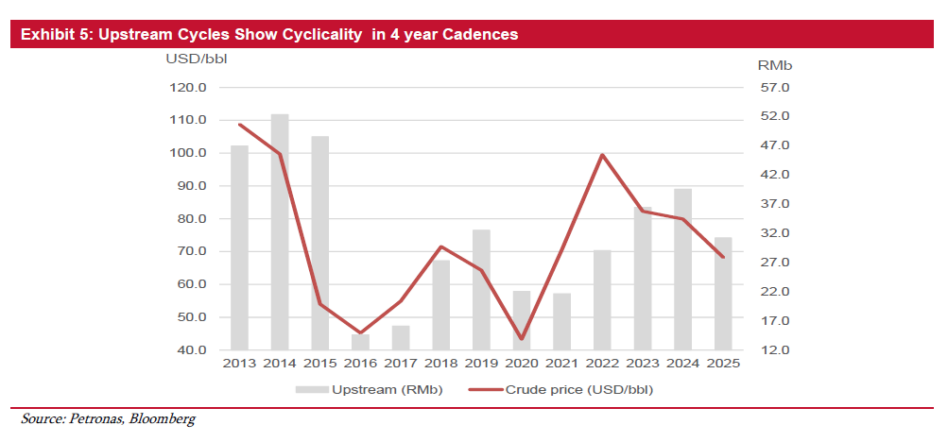
Kenanga believes Petronas’ upstream capex follows a four-year cycle, with spending typically lagging oil price peaks by one to two years.
With crude prices potentially peaking in 2026, upstream capex could recover in 2027 and peak in 2028.
Petronas’ restructuring of its Sarawak upstream portfolio is seen as an encouraging early sign.
Partnerships and asset transfers involving Eni, EnQuest and Vestigo could allow operators to increase spending without being hampered by the ongoing Petronas-PETROS legal dispute.
Kenanga expects upstream service providers to see weak earnings in 2026 before a potential two-year recovery from 2027.
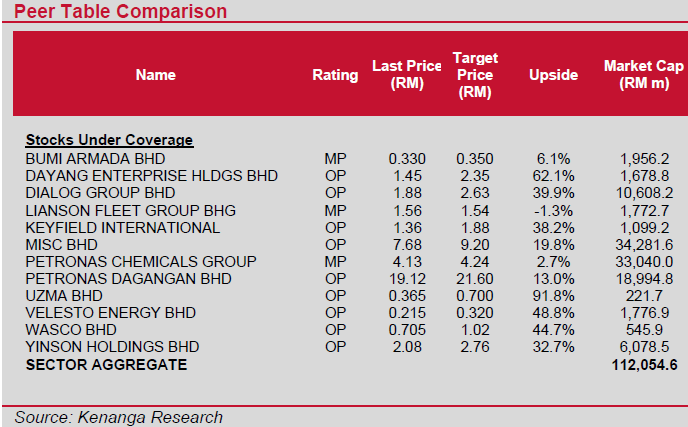
It recommends investors gradually accumulate these stocks on weakness. KEYFIELD is its preferred upstream-services pick, followed by DAYANG.
DIALOG remains its top large-cap choice, while MISC is favoured as a tactical play on sustained tanker rates amid geopolitical disruptions.
The report also expects tanker rates to remain elevated through 2027, as shipping routes disrupted by the Red Sea and Strait of Hormuz may take time to normalise.—Oct 5, 2026