
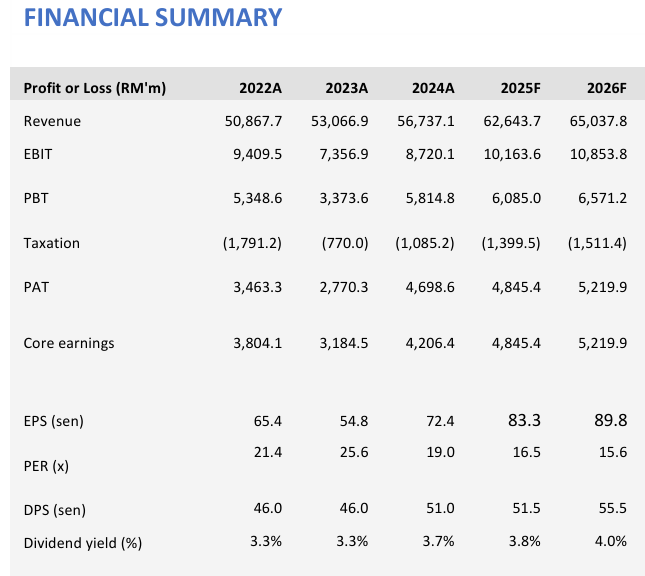
MBSB Research maintains their BUY recommendation on Tenaga Nasional. The latest tariff framework under RP4 provides greater stability and transparency, especially through the dynamic Automatic Fuel Adjustment (AFA) that removes the lag in fuel cost recovery thus, protecting Tenaga from fuel price swings.
Electricity demand is also expected to be strong this year, with a projected growth of 3.5% to 4.5%.
“We visited the Tuanku Muhriz Power Station (SJTM) in Port Dickson recently, which houses two units of 1,000MW coal-fired power plants owned and run by Tenaga Nasional’s 70% subsidiary, Jimah East Power Sdn Bhd (JEP),” said MBSB.
The remaining 30% is held by 3B Power Sdn Bhd, a subsidiary of Mitsui& Co Ltd and The Chugoku Electric Power Co Inc.
The first unit achieved commercial operation date (COD) in Aug-19 and the second unit in Dec-19, about four years after construction began in Nov-15.
Built on top of a 257-acre claimed land, the total project cost was RM12.1 bil, which was financed using a mixture of debt and equity finance.
SJTM has an efficiency of up to 43% as compared to about 35% for conventional thermal plants. It can deliver 2,000MW of output, powering 10% of Peninsular Malaysia’s electricity demand or about 2 mil households.
The coal supplies for SJTM are by TNB Fuel Sdn Bhd, which are sourced mainly from Indonesia (98%). The annual consumption at the power station is approximately 8 mil metric tonnes, equivalent to eight Panamax vessels per month.
The Renewable Energy Applications for Clean Hydrogen (REACH) is one of the projects launched by Tenaga under the National Energy Transition Roadmap (NETR).
Still in the pilot phase, REACH aims to assess how green hydrogen can be used directly on-site for generator cooling and other practical applications.
At SJTM, Tenaga has installed a 500kWp solar rooftop and a 1MWh battery energy storage system (BESS). This is meant to provide a clean energy source to support hydrogen production.
Project REACH at SJTM can produce 132,000m³ of green hydrogen annually, but only 25,000m³ is required for the station’s own use, mainly for cooling generators.
This could be a potential new income stream for Tenaga if it decides to explore commercialisation in future. We learnt that offtakers were willing to pay USD4 to USD6 per kg of green hydrogen, as compared to USD1 to USD2 for grey hydrogen.
Tenaga’s share price has weakened since the past month, primarily due to concerns over its tax disputes after the Federal Court ruled in favour of the Inland Revenue Board for the tax dispute of RM1.25 bil against Tenaga for the year of assessment 2018.
On 2nd July, the Federal Court ruled that for Tenaga, the applicable schedule is 7B (Investment Allowance) instead of 7A (Reinvestment Allowance).
While this ruling only pertains to 2018, the concerns now date back all the way to 2003 and up to 2023, with a potential amount under dispute of RM8.45 bil, or equivalent to RM1.45 per share and we believe the worst-case scenario has been largely priced in.
Tenaga’s share price fell -12.6% by the end of Jul-31 to RM13.02 and has recently regained some composure, up to RM13.72 yesterday.
The group began with the resubmission process under Schedule 7B with the Ministry of Finance, involving about 67,000 projects.
We do not expect any one-off provisions to be made this quarter and therefore, would not affect the dividend payout that can be expected for the first half of financial year 2025. —Aug 26, 2025
Main image: Business Today