
CUNNING marketing ploy or standard operating procedure?
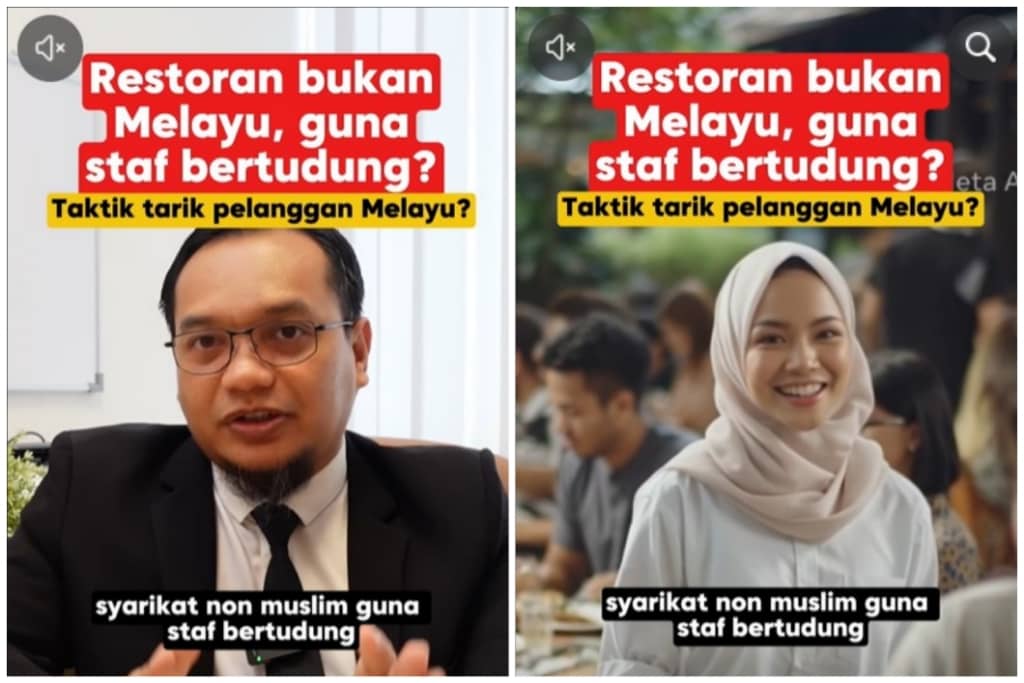
This was the fine line non-Muslim F&B (food & beverage) proprietors are straddling when they have tudung-clad Muslim staff on the payroll.
This highly sensitive issue was broached by lawyer Muhammad Hawari Hanafi in an explanatory video on his legal firm’s Facebook page, Hawari Law.
This much debated topic often has Muslims questioning whether it is right to employ staff to give the impression that the eatery is “Muslim-friendly” or “halal”.
“Is the tudung part of the uniform or is it misleading to the customer?” queried the Shah Alam-based legal expert.
“Can a non-Muslim restaurant owner insist that female Muslim staff wear tudung, including those who don’t usually wear elsewhere to make it look more reassuring to Malay-Muslim diners?”
The short answer is that it is not automatically wrong, according to Hawari whose firm specialises in conveyancing and real estate matters, among other fields.
What matters is how it is presented to the customer. For instance, if the management – whether Muslim or otherwise – has determined a set uniform for staff that includes aprons, hairnets, colour-co-ordinated shirts and yes, tudung, to present a professional image.
Wrong if intended to create deception
If it has been agreed in the contract and terms of employment that this is part of the restaurant’s uniform for the purposes of hygiene, uniformity and professionalism, Hawari contended that it is perfectly acceptable.
However, problems surface when this image is used to present an untrue image. For instance, a non-Muslim owner uses tudung-clad staff to misleadingly present the outlet as having halal status when it did not and that the list of ingredients used in the restaurant are vague.
“The perception is that the restaurant is Muslim-owned and thus confirmed halal and safe for Muslim consumption. This is where problems arise as it is misleading,” argued the lawyer.
It was pointed out that many Muslims take this issue of halal very seriously as they don’t just look for the official JAKIM’s (Islamic Development Board Malaysia) logo per se but also look at the staff’s dressing, name of the establishment, the store’s environment, the type of language used as well as the overall feel of the premises.
According to International Islamic University Malaysia (IIUM) alumni, when an image is purposely built to give the perception that an establishment is halal when it is not, then it could face legal consequences for the misleading image.
“Don’t present an image that is untrue – that the restaurant is suitable for Muslims when it isn’t certified or uses ingredients that could compromise their religious obligations,” advised Hawari.
However, not everybody was fully enlightened by the lawyer’s somehow long-winded explanation. One Muslim commenter simply insisted that there should be no grey area.
“No halal logo means not halal,” was the simple assertion. But that stance was met with another problematic issue of prolonged JAKIM approval, especially by non-Muslim business owners, claimed another commenter.
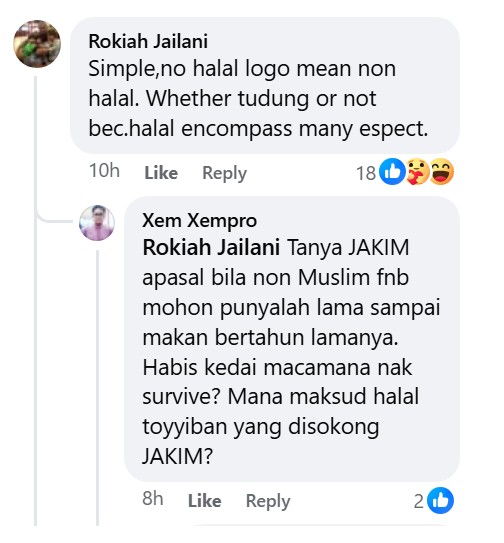
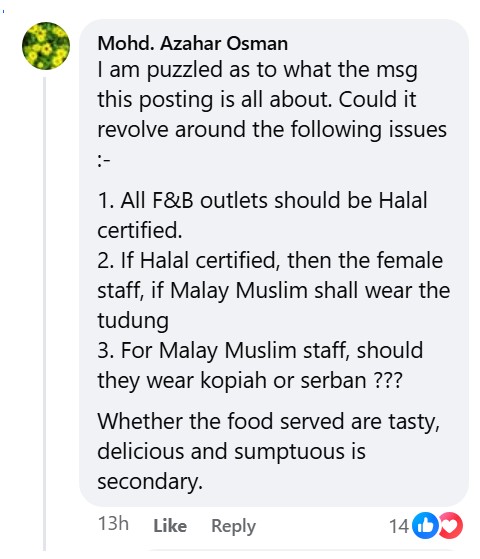
Another Muslim observer asked what was the intended messaging of this post. Was it regarding the hotly debated topic of all restaurants that serve Muslims needing mandatory halal certification?
He also sarcastically asked if male Muslim staff in such outlets would be required to wear kopiah (male skull cap) or serban (turban)
The confusion was evident with one budding “Christian” entrepreneur unsure of what the hiring process was if he were to open a neighbourhood coffee shop.
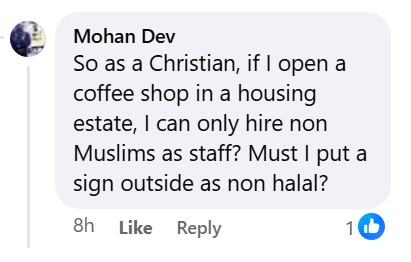
Some others also argued that this presented a ‘damned if you do, damned if you don’t’ scenario when it came to hiring Muslim staff.
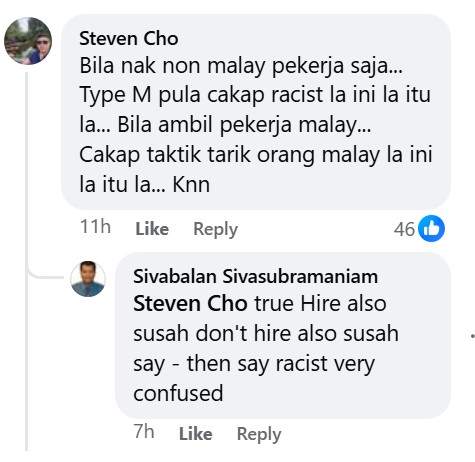
As seen from the various comments, despite the lawyer’s efforts to clarify the matter, the issue is far from clear.
Should non-Muslim owners completely stop hiring Muslim staff?
Since it is repeatedly pointed out that halal status also covers cleanliness and hygiene, shouldn’t the same criteria apply to Muslim restaurants?
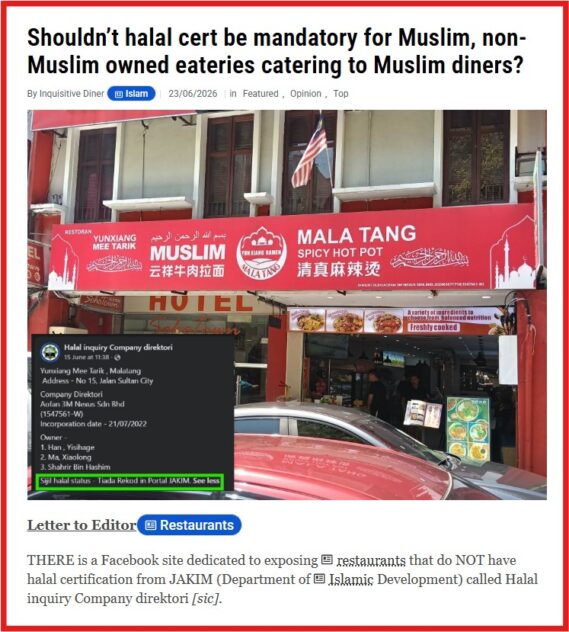
Would they, too, not be misleading Muslim customers by appearing to be halal when their operations clearly do NOT meet the required standards.
Judging from the feedback, it is a complex issue that does not seem to have been made any clearer by the lawyer’s advice. Expect it to rumble on. – July 14, 2026