
LOCAL plantation companies delivered a largely steady performance in quarter two 2026 (2Q26), with most players meeting expectations despite mixed production trends and rising weather concerns.
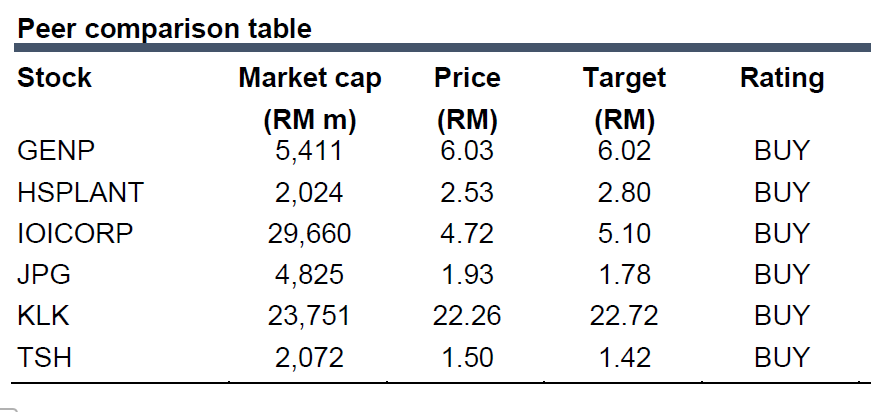
During the recently concluded 2Q26 results season, five out of six planters under Hong Leong Investment bank (HLIB)’s coverage delivered results that were in line with expectations, while JPG reported earnings that fell short of expectations, as its fresh fruit bunch (FFB) production missed their estimates.
Aggregate core earnings edged up 1% to RM861 mil in 2Q26, supported by stronger upstream performance.
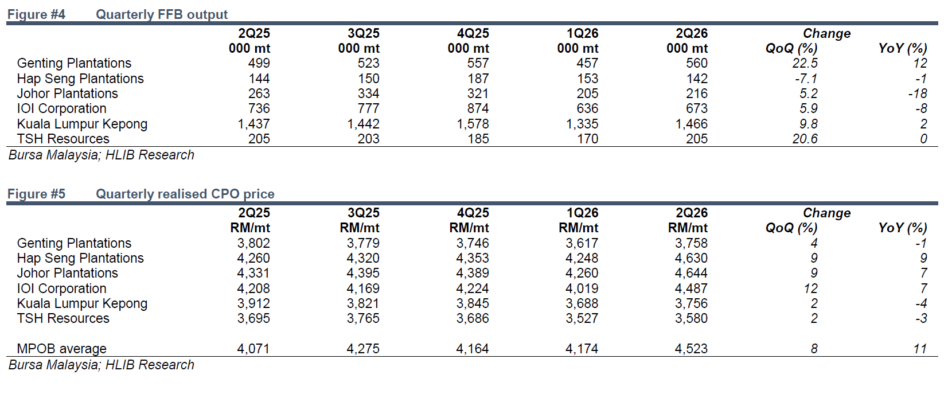
The improvement was driven by a broad-based seasonal recovery in fresh fruit bunch (FFB) production, alongside higher realised palm product prices.
However, the gains were largely offset by weaker earnings from HSP, JPG and KLK, with each company facing different operational and financial challenges during the quarter.
Earnings among plantation companies were mixed, with HSP’s core profit affected by weaker crude palm oil (CPO) and palm kernel sales volumes.
JPG, meanwhile, was impacted by a higher effective tax rate, while KLK’s earnings came under pressure from its share of losses from associate Synthomer.

Fresh fruit bunch (FFB) production trends were similarly uneven among the planters under HLIB’s coverage in 2Q26.
Three of the six companies recorded lower production, largely due to changes in cropping patterns. In JPG’s case, output was also affected by its more aggressive replanting programme.
Weather conditions have also become increasingly dry since June 2026, with the ongoing El Niño phenomenon appearing to have a stronger impact in Indonesia than in Malaysia.
While it is still too early to determine the full effect on plantation productivity, prolonged dry conditions could eventually weigh on yields, although the impact may only become evident after a time lag.
The downstream segment, however, showed signs of improvement on both a year-on-year and quarter-on-quarter basis.
This was driven mainly by stronger demand for oleochemicals, following supply chain disruptions in the petrochemical industry linked to heightened tensions in the Middle East.
Looking ahead, the operating environment remains challenging, particularly given continued competition from Indonesian producers.
Nevertheless, near-term demand for oleochemicals is expected to remain relatively supportive as buyers replenish inventories amid geopolitical uncertainties and prepare for the implementation of the European Union Deforestation Regulation (EUDR).
“We maintain our Overweight stance on the sector, underpinned by our expectation that elevated CPO prices will be sustained through 2H26, supported by tightening supply conditions and resilient demand,” said HLIB.—Sept 7, 2026
Main image:fkvap.com