


THE Malaysian Micro Business Association (MAMBA) has cautioned against politicising Malaysia’s Foreign Worker Centralised Management System (FWCMS) as such action risks undermining the meaningful progress already achieved in strengthening governance, efficiency and transparency in the recruitment of foreign workers.
Drawing reference to recent statements by Bestinet Sdn Bhd, MAMBA president Tan Peng Beng pointed to how implementation of FWCMS and the broader push towards digitalisation have addressed long-standing systemic weaknesses that previously plagued the foreign worker recruitment ecosystem.
“The transition from fragmented, manual processes to a centralised digital platform has resolved many of the inefficiencies and leakages that once enabled abuse, delays and opacity,” he stressed in a media statement.
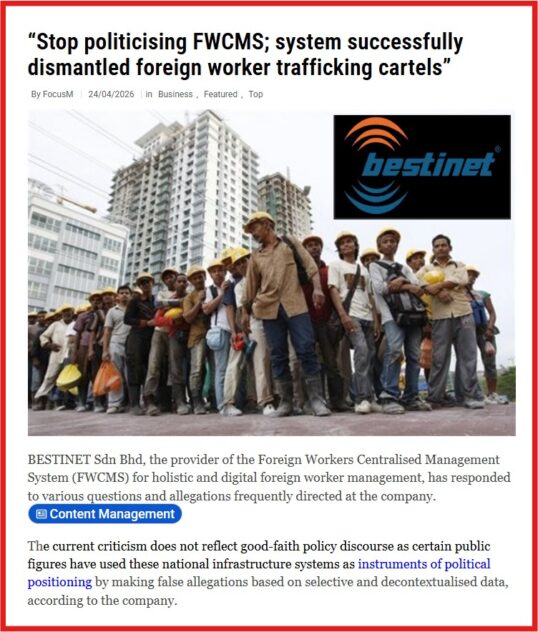
Tan further highlighted that micro businesses and SMEs – including hawkers, market traders, pasar malam operators, small sundry shop owners and even workshop proprietors – who form the backbone of Malaysia’s economy are heavily reliant on migrant workers to support their daily operations.
“Any disruption to the system will not just affect large corporations but will disproportionately impact micro businesses and small enterprises, creating uncertainty, operational disruptions and financial hardship for those who can least afford it,” he warned.
Proven continuity, relevance
Tan further stressed that from the perspective of businesses on the ground, the system is functioning effectively and has brought tangible improvements.
“For many employers, particularly within the micro and SME segments, the system works. It has improved processing timelines, enhanced transparency and provided a more structured and reliable framework that businesses can depend on,” he observed.


Tan further underscored that the FWCMS has successfully operated across five different government administrations, a track record which in his view reflects both the robustness of the system and the stringent processes underpinning its implementation and oversight.
“Very few systems can demonstrate continuity and relevance across multiple administrations. This alone speaks volumes about the system’s resilience and institutional value,” he acknowledged.
Importantly, Tan highlighted that many of the previous inefficiencies – particularly on the demand side involving employer applications and approvals – have been significantly addressed through digitalisation.
However, he acknowledged that challenges remain, especially those originating beyond Malaysia’s jurisdiction, including issues within source countries such as recruitment practices, documentation integrity and worker welfare.
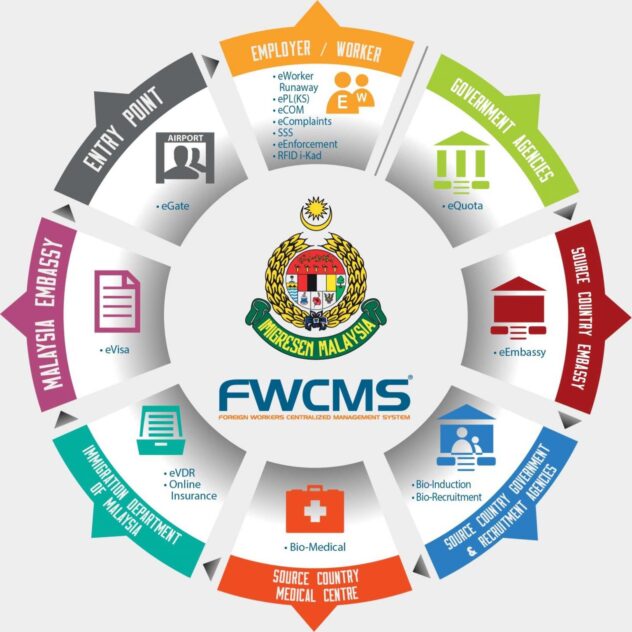
“These are structural and cross-border issues that cannot be resolved by Malaysia alone. What’s needed is the continued evolution of solutions, including the use of more advanced digital technologies, cross-border integration and stronger international cooperation,” he opined.
While acknowledging that public debate on FWCMS is both necessary and healthy, Tan reckoned that such discourse must be constructive and grounded in facts rather than driven by political agendas.
“We welcome scrutiny and discussion but it must be responsible. Politicising the system without a full appreciation of its impact risks reversing the gains that have been made.”
He therefore urged all stakeholders – policymakers, industry players, civil society and technology providers – to work collaboratively towards a more holistic and sustainable solution.
“Our collective priority should be to protect the welfare of migrant workers, eliminate profiteering and ensure that Malaysian businesses, particularly micro businesses and SMEs, are supported by a fair, efficient and transparent system,” asserted Tan.
“This is not an issue for political contestation but one that demands unity and practical solutions.” – April 26, 2026