

THE Budget 2027 is expected to be mildly expansionary but disciplined, with targeted household support and continued investment in productivity and infrastructure.
Revenue is forecast to rise 5.5% to RM383.3bil, while operating expenditure is expected to increase 4.6% to RM378.4bil.
Development spending is projected at RM82.4bil, narrowing the fiscal deficit to 3.3% of GDP from 3.5% in 2026.
Household assistance remains a key pillar, with STR and SARA allocations potentially rising to around RM17bil from RM15bil.
A possible minimum wage increase to RM1,800-RM2,000 could boost purchasing power but raise costs for labour-intensive sectors.
On taxation, Apex does not expect major broad-based taxes, instead anticipating refinements to SST, wider e-invoice adoption and greater clarity on carbon-tax implementation.
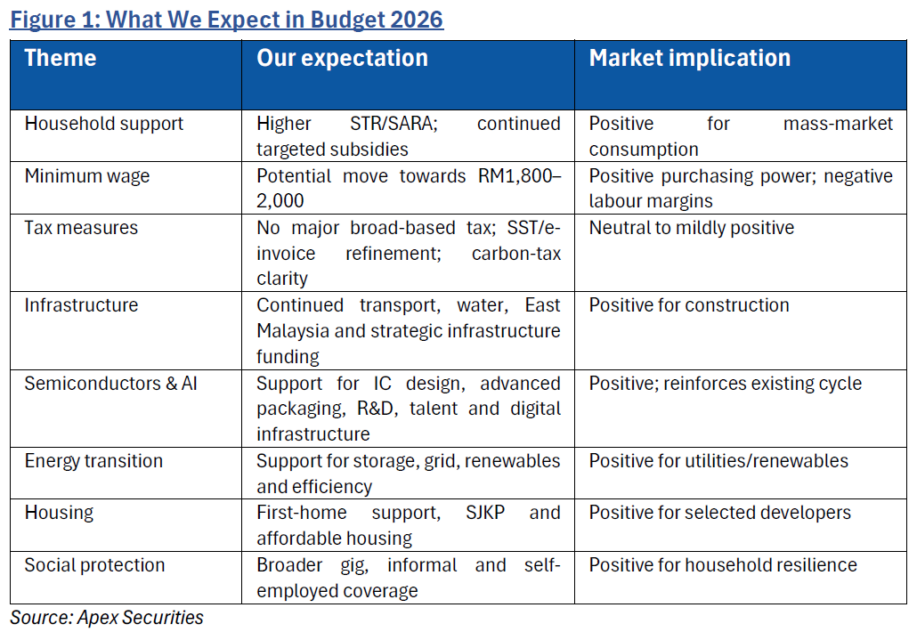
Support for semiconductors, AI, digital services, energy transition and other strategic industries is also expected.
The research house expects Budget 2027 to be mildly positive for the FBM KLCI, but not strong enough to trigger a broad market re-rating.
It maintains its end-2026 KLCI target at 1,770. Construction is favoured on continued infrastructure spending, while Technology remains a key structural-growth theme supported by AI and semiconductor demand.
Energy and Utilities could benefit from grid investment, renewables and storage, while Property should gain selectively from housing measures and infrastructure development.
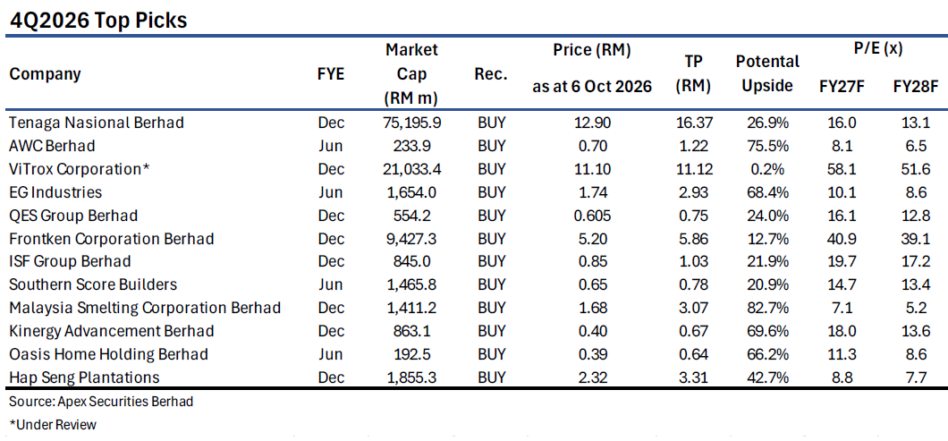
Apex also maintains a positive view on plantations, although the sector remains primarily driven by crude palm oil prices.
It forecasts CPO prices at RM4,500 per tonne in 2026 and RM4,700 per tonne in 2027.
Overall, the research house expects Budget 2027 to reinforce existing investment trends rather than create a new stimulus cycle, favouring companies with resilient earnings, visible order books and exposure to structural themes including AI, semiconductors, data centres and energy infrastructure.—Oct 7, 2026
Main image: ideas.org.my